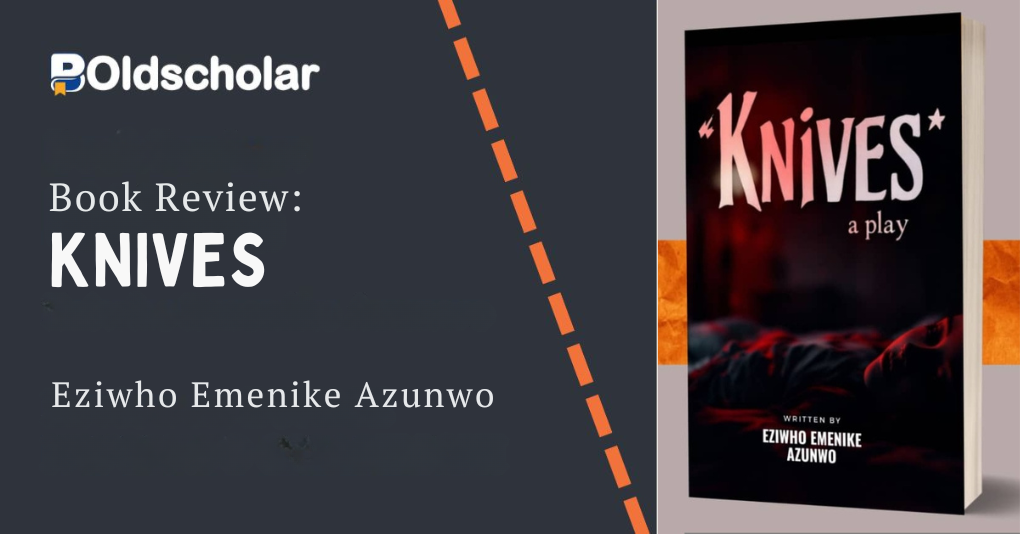
Book Title: Knives
Author: Dr. Eziwho Emenike Azunwo
Reviewer: Ayibaokpo Tarimoboere Promise
Publisher: Covenant Daystar Publishers
Pagination (number of pages): 79 pages
Year of Publication: 2026
Institution: Rivers State University, Port Harcourt,
Department of Theatre and Film Studies.
INTRODUCTION
Azunwo's Knives is a contemporary Nigerian social drama that confronts the painful realities of injustice, corruption, and the silencing of the vulnerable in society. Set within an Igbo cultural context but told in English for broad accessibility, the play uses realistic and naturalistic storytelling to expose how wealth and power can distort truth. 12-year-old Ella is sexually assaulted by Obi, a 23-year-old from a wealthy and influential family. What follows is not just a medical crisis, but a moral one. As Ella’s mother, Mrs. Odili, and their neighbor, Peter, demand justice, they encounter a system that has already been bought. Obi’s father, Honorable Nduka, bribes the police to rewrite the crime, turning rape into a “relationship” and erasing Ella’s age and consent from the record.
At its heart, "Knives" is a conflict between two worlds: the world of influence, where money can create a new narrative, and the world of integrity, represented by Mrs. Odili, who refuses financial settlement and chooses to trust God over a compromised system. The story builds toward heartbreak when Ella dies before justice arrives, and it closes with a direct challenge to the audience through Uche's monologue, which asks: How human are we if we cannot protect the vulnerable?
Through its blend of Igbo names, English dialogue, and a stark focus on class and power, "Knives" is not only the story of a family’s loss. It is a mirror held up to a society where “justice is caged,” and a call to speak before silence costs more lives. The play is urgent, moral, and unflinching. Its purpose is to provoke reflection, discomfort, and accountability.
SYNOPSIS
The story is a social drama about injustice, power, and the silencing of the vulnerable. 12-year-old Ella is raped by Obi, a 23-year-old man and the son of a wealthy family. The assault leaves her hospitalized in critical condition. Her mother, Mrs. Odili, and their neighbor, Peter, act immediately to seek justice for Ella. Obi is questioned by his father. He denies raping her and claims he was in a romantic relationship with Ella. His father, Honorable Nduka, uses his influence and wealth to corrupt the system. He bribes the Divisional Police Officer [DPO] to create a false narrative that Ella and Obi were in a consensual relationship, and that no rape occurred. When Mrs. Odili and Peter return to the police station, the DPO repeats the fabricated story. He tells them Ella was in a relationship with Obi and was not raped. Mrs. Odili and Peter reject this. They argue that it is legally and morally impossible for a 12-year-old minor to consent to a 23-year-old man. The DPO dismisses their argument and offers that all of Ella’s medical expenses will be covered meanwhile, Ella must “wake up” to give her own account. Mrs. Odili refuses any financial assistance. She declares that God will fight for her and her daughter, and she walks out of the station with Peter. Later, a representative from a humanitarian agency, Uche, visits Mrs. Odili to assure her that the agency will pursue justice. Before any help can materialize, a doctor interrupts with the news that Ella has died. In the final scene, the lights dim on Uche. He steps forward and addresses the audience directly. His monologue condemns a world where “justice is caged” and wealth protects wrongdoing while the poor suffer in silence. He challenges the audience: to repent if guilty of injustice, and to speak out if silent in the face of evil. He warns not to wait until the tragedy touches one’s own family, then bows and ends the play.
THEMES
The story is a social tragedy that uses one family’s loss to expose wider systemic problems. The main themes are:
Injustice and Abuse of Power: The central theme. Wealth and political influence are shown to override the law. Honorable Nduka bribes the DPO to rewrite the crime from “rape” to “relationship.” The police, who should protect the vulnerable, become tools for the powerful. This shows how justice can be “caged” when money buys narratives.[Uche’s monologue]
The Exploitation and Silencing of the Vulnerable: Ella, a 12-year-old child, has no voice in the system. Her age makes legal consent impossible, yet the system tries to erase that fact. The story highlights how children, women, and the poor are most exposed to harm, and are often the least protected by institutions.
Corruption vs. Moral Integrity: This is set up as a direct conflict. On one side: Nduka and the DPO choose corruption, lies, and financial settlements. On the other: Mrs. Odili refuses money and insists on truth, saying “God will fight for her and her daughter.” Her refusal shows integrity even when the system offers an easy exit.
Grief, Loss, and the Failure of Institutions: The story moves from a fight for justice to mourning. Despite Mrs. Odili's resistance and the humanitarian agency’s intervention, Ella dies before justice arrives. The theme is that institutional failure does not just delay justice, it costs lives.
Silence, Complicity, and Moral Responsibility: Uche's final monologue shifts the focus to the audience. He condemns both active wrongdoing and passive silence: “If you are silent in the face of evil, speak.” The play argues that a society that protects the powerful and ignores the weak is collectively responsible.
Wealth vs. Poverty: The conflict is also economic. Obi’s wealth gives him “liberty to inflict more suffering,” while Mrs. Odili “has nothing” and must fight with faith alone. The story critiques a system where class determines access to justice.
The story uses Ella’s case to argue that when power corrupts justice, silence becomes complicity, and integrity alone cannot protect the vulnerable without systemic change.
CHARACTERIZATION
Mrs Odili: Mother of Ella, the 12-year-old victim, she is not wealthy, has no political title, money, or institutional power only her status as a mother and citizen. Mrs. Odili is the moral and emotional center of the adult world in "Knives." She is defined by grief, defiance, and integrity in a system built to break both.
Ella: Daughter of Mrs. Odili. Ella is 12 years old, raped by Obi, hospitalized in critical condition, and later dies.
Peter: Peter is a kind, firm, and supportive neighbor whose presence beside Mrs. Odili embodies moral courage, even though his voice is ignored by a corrupt system. Peter is the play’s representation of community solidarity. He is not central to the plot, but he is essential to its moral landscape a reminder that silence is a choice, and so is support.
Ada: Mrs. Odili’s neighbour
Mr. Nduka: He is the father of Obi, the 23-year-old accused of assaulting 12-year-old Ella. Honorable Nduka is the face of wealth, influence, and impunity in Knives. He is defined by power, entitlement, and the ability to buy silence in a system where money outweighs law.
Mrs Nduka: The mother of Obi.
Obi: The 23-year-old perpetrator of sexual assault against Ella, a 12-year-old child. Son of Honorable Nduka. He is privileged by class. His father’s wealth and influence shield him from immediate legal consequences.
DPO: Divisional Police Officer in charge of the station where Ella’s case is reported. He embodies authority without integrity, and shows how power can be bent when money and influence enter the room. Instead of fighting for justice, he accepted bribe and tossed Ella's case aside.
Uche: Social worker interested in Ella’s case.
Other characters: Pharmacist, Doctor.
LANGUAGE AND STYLE
The entire story is written in English. This choice makes the play accessible to a national and international audience who may not understand Igbo. English is used for all dialogue, legal discussions at the police station, medical updates, and Uche’s final monologue. It gives the story clarity and a wider reach, especially for social issues like child abuse and corruption that concern all Nigerians. While the language is English, the characters are rooted in Igbo culture through their names: Odili, Nduka, Obi, Uche. These are distinctively Igbo names that immediately locate the story in Southeast Nigeria. The names do more than label characters, they signal family values, social status, and community expectations. The mix creates a unique cultural flavor. The audience reads/hears English, but they are constantly reminded that the events are happening within a specific Nigerian, Igbo context. This blend reflects the real-life linguistic reality in many Nigerian homes: people speak English publicly, but their identity, names, and worldview remains. It highlights the complexities of identity, modernity, and heritage without switching into Igbo language.
DRAMATIC TECHNIQUES
"Knives" relies on several techniques to make its social message land hard. The most prominent ones are:
Direct Address / Breaking the Fourth Wall: Uche’s final monologue to the audience, he steps out of the story and speaks directly to spectators: “If you are guilty of injustice, repent. If you are silent, speak.”
This collapses the distance between stage and audience. It turns viewers from passive watchers into moral participants, and it makes the play feel like a public indictment, not just a family tragedy.
Tragedy/Tragic Structure: Knives follows classical tragedy. An innocent suffers because of a corrupt system, the audience experiences pity for Ella and fear that this could happen in a real society. The inevitable, bleak ending creates catharsis and moral discomfort.
Symbolism: Ella symbolizes vulnerability, innocence, and silenced truth. She never speaks, so her absence becomes symbolic of how systems erase victims. The title “Knives” suggests invisible cuts the pain inflicted by power, money, and silence that leave no external wound but kill nonetheless.
Realism / Social Drama: The police station scene, bribes, hospital setting, and use of Nigerian titles like “Honorable” and “DPO.” The play is grounded in recognizable Nigerian social reality. By using realistic dialogue, class conflict, and institutional settings, it avoids fantasy and forces the audience to see this as something that could happen now.
Dramatic Irony: The DPO claims Ella and Obi were in a “relationship,” while the audience knows she is 12 and cannot consent. The audience understands the truth the corrupt characters are trying to hide. That gap creates tension and moral outrage.
SOCIETAL - COMMENTARY
"Knives" is more than a tragic family story. It functions as a mirror to Nigerian society, and to any society where power, wealth, and silence determine who gets justice. The play exposes a two-tiered system of justice. Obi’s father, Honorable Nduka, does not argue facts. He buys a narrative. With one bribe to the DPO, rape becomes a “relationship.” This reflects a real social anxiety: that wealth can purchase impunity, while poverty leaves you exposed. The poor, like Mrs. Odili, must fight with faith and moral argument alone, while the rich fight with influence.
Uche’s line captures it:
“The man with wealth has the liberty to inflict more suffering”
The police station should be a place of protection but in "Knives," it becomes a site of betrayal. The DPO dismisses legal reality that a 12-year-old cannot consent and repeats a lie because he has been paid. When citizens can no longer trust the police, courts, or medical-legal processes, the social contract breaks down. Mrs. Odili’s exit, “God will fight for her,” is both courage and indictment. It shows a mother who has lost faith in the state and must appeal to a higher authority. Ella’s age is the clearest moral line in the story, yet it is the first thing the system tries to erase. The play comments on how child sexual abuse is often minimized, re-framed, or silenced to protect powerful men and family reputations. Ella dying before she can speak, the play shows the ultimate cost of that silence: the victim never gets to narrate her own truth. The story divides society into three groups: the perpetrators, the compromised, and the resisters. Nduka and the DPO represent active corruption.
The broader society is represented by the audience Uche addresses:
“If you are silent in the face of evil, speak.”
The play argues that silence is not neutrality. In a system where the poor “must be cautious even in their own pain,” inaction becomes complicity. "Knives" warns that when money controls narratives, institutions fail the vulnerable, and society chooses silence, justice becomes a luxury instead of a right.
CRITICAL EVALUATION STRENGTHS
Unflinching Social Relevance: The play tackles issues people often avoid on stage: child sexual abuse, police corruption, class impunity, and the silencing of victims. By putting a 12-year-old minor at the center, it forces the audience to confront a legal and moral line that cannot be debated: a child cannot consent. This makes the social commentary immediate and urgent.
Culturally Specific, Universally Resonant: The use of Igbo names, Nigerian titles like “Honorable” and “DPO,” and an English-Igbo context roots the story in a real Nigerian setting. Yet the themes like wealth buying justice, institutions failing the poor, silence as complicity are recognizable across many societies. That balance helps it work both locally and beyond.
Direct Audience Confrontation: Uche breaking the fourth wall to address the audience is a major strength. Instead of ending quietly, the play demands accountability:
“If you are guilty; repent. If you are silent; speak.”
This turns spectators into participants and prevents the audience from leaving with passive sympathy only.
WEAKNESS
Limited Agency for the Victim: Ella, the central victim, never speaks or appears on stage after the assault. She is hospitalized and dies before she can narrate her own experience. While this mirrors real silencing, it also means the story is told about her, not through her. The audience never hears Ella’s voice, so the emotional center shifts to Mrs. Odili and Uche. This can make the play feel like it’s using Ella’s tragedy to make a point, instead of centering her humanity.
CONCLUSION
"Knives" ends not with courtroom justice, but with a wound that the audience is forced to carry. Ella’s death exposes the final cost of a system where money buys truth and power silences victims. Honorable Nduka’s bribery succeeds legally, but it fails morally leaving behind guilt, complicity, and a community that must live with what it allowed. Mrs. Odili’s refusal to accept settlement becomes the play’s moral anchor. Though she loses her daughter, she does not lose her integrity. Her grief stands as both indictment and testimony against a society that trades justice for influence. The play closes with Uche’s direct address, turning the story from Ella’s tragedy into our responsibility.
"Knives" does not offer easy comfort. Instead, it cuts to provoke us, to shame our silence, and to demand action before another child is sacrificed on the altar of power and greed.
REFERENCES
Azunwo, E. E. (2026). Un-destined Fate: A play. Port Harcourt: Covenant Daystar Publishers.
Share this post


Be the first to comment on this post