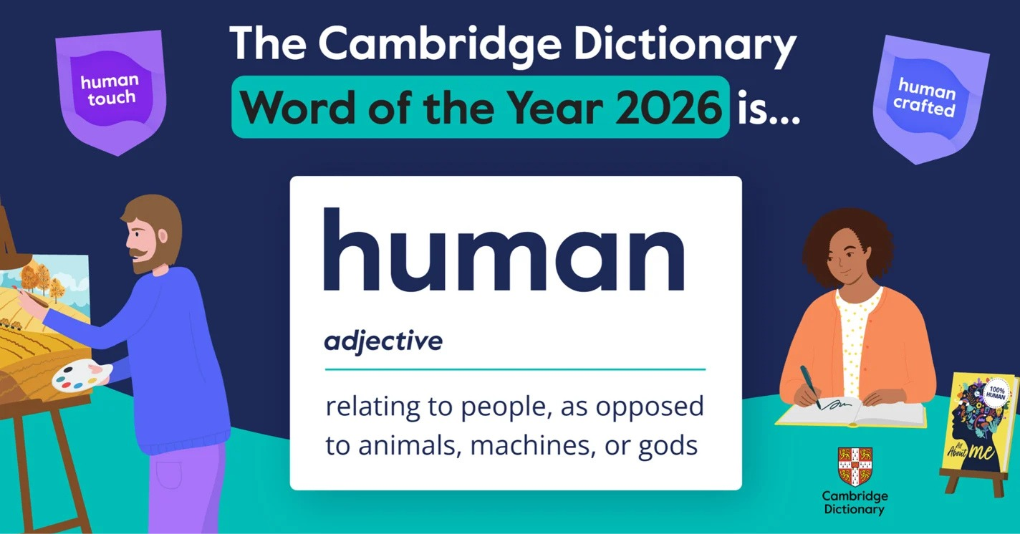
The Cambridge Dictionary has named ‘human’ its ‘Word of the Year’, citing growing debates about human identity and the increasing influence of artificial intelligence.
The dictionary defines ‘human’ as “having the qualities, faults, and feelings that people have, as opposed to gods, animals or machines”.
In its announcement, Cambridge Dictionary said the selection reflected questions about what people might lose as they rely increasingly on AI.
Cambridge lexicographer Colin McIntosh said concerns about outsourcing thinking to AI had prompted people to reconsider their dependence on the technology.
He said the growing use of expressions such as “human-made” reflected efforts to distinguish work and qualities produced by people from those generated by AI.
AI pioneer and Nobel laureate Geoffrey Hinton warned that “we’re creating alien beings”, saying he was willing to “choose humans”.
Microsoft co-founder Bill Gates argued for “human-reserved jobs”, including caregiving, which he said should not be taken over by machines, in an essay published on his website.
The dictionary stated that concerns about AI’s effect on creativity have prompted artists and writers to oppose the unauthorised use of human-simulated content by technology companies.
The publication noted that the Human Artistry Campaign and Artists’ Rights Alliance have brought together artists including actors Scarlett Johansson and Cate Blanchett, musicians Billie Eilish and LeAnn Rimes, and authors Jodi Picoult and Jonathan Franzen. The groups describe the issue as an “assault on human creativity”.
It also referenced Rachel Adams, an expert in AI governance and human rights who said AI had revived longstanding questions about human identity.
“AI brings us back to questions that we’ve asked for millennia: who are we, what does it mean to be human?” she said.
Ms Adams said AI could deepen existing inequalities but also had the potential to address them, depending on how society chose to use the technology.
Tom McClelland, a philosopher of science at the University of Cambridge, said consciousness, creativity and compassion were central to questions about what distinguishes humans from artificial beings.
He said society could still decide which aspects of humanity it wanted to preserve as AI developed.
Share this post

Be the first to comment on this post