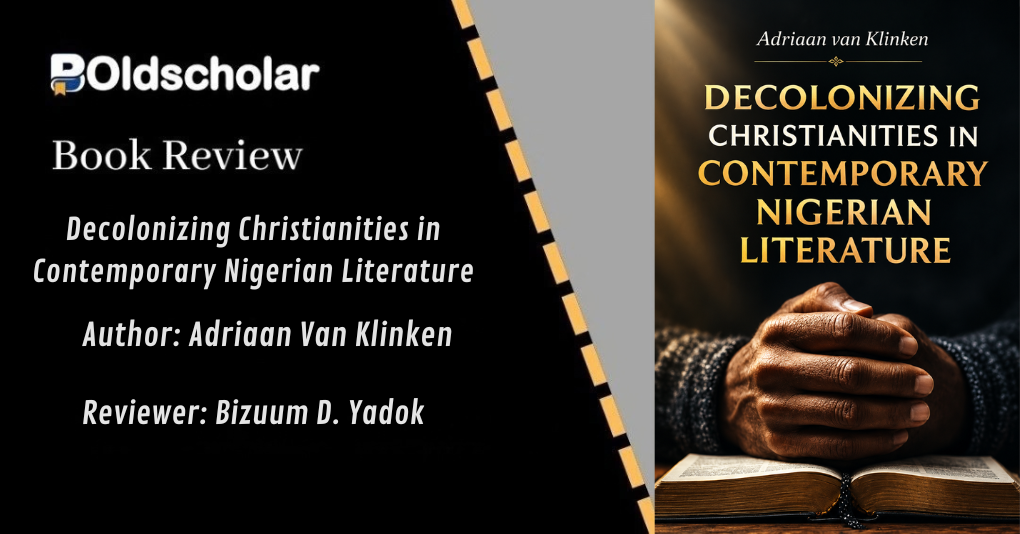
A Review OF Adriaan Van Klinken’s Decolonizing Christianities in Contemporary Nigerian Literature

Klinken draws our attention Adichie’s portrayal of decolonized Catholicism even in Marian devotion which, still, does not deny the essence of the faith but provides a profitable engagement of Africans with the church and its beliefs.
Sep. 28th 2026
A Review OF Adriaan Van Klinken’s Decolonizing Christianities in Contemporary Nigerian Literature


Recently, in a conversation about evolution of mankind and migration of religions across the globe, my friend casually remarked that, “even the Oyibo people are surprised at what Nigerians have turned their Jesus into.” The word “Oyibo” is a pidgin word even though rooted in one of the native languages of southern Nigeria which refers to Europeans. It must, however, be stated that Christianity was not first brought to Africa by Europeans but its presence in different forms in Nigeria is credited entirely the West. Nonetheless, the spread and practices of Christianity are further propelled by the religion’s appropriation to indigenous cultures of the Nigerian society. I believe this thought might have informed Adriaan van Klinken’s seminal book, Decolonizing Christianities in Contemporary Nigerian Literature, which seamlessly intersects Nigerian literature and the various shades of the Christian faith therein. 

Fiction may be perceived as fact to the extent that it reflects real happenings in the society. It is on this note that Klinken makes a case for the interrogation of Christianity embedded in imagination of real authors. Accordingly, he uncovers means by which Nigerian prose-fiction writers decolonize Christianity in contemporary fiction which significantly deviates from the hegemonic culture-clashing versions of the much older generation of writers. Thus, the writer attributes the spread of Christianity in Nigeria, partly, to inculturation – a phenomenon where certain cultural motifs and practices are infused into the Christian faith thereby producing variants of Christian denominations. In the first chapter, for example, using material religion and theopoetics as working theories, Klinken shows how the Bible in its physical form is readily used as a talisman or good-luck charm using Uzodinma Iweala’s Beast of No Nation and Chris Abani’s Song for Night, relating them to the trauma of the Nigerian Civil War and religious memory. As such, the notion of forgiveness is subjected to further questioning especially in the face of collective trauma. 

The book also states how the Christianity, particularly the Catholic Church, is brewed in an African pot with reference to Chimamanda Adichie’s Purple Hibiscus. Klinken draws our attention Adichie’s portrayal of decolonized Catholicism even in Marian devotion which, still, does not deny the essence of the faith but provides a profitable engagement of Africans with the church and its beliefs. Decolonizing Christianity in the area of sexuality however proved to a laborious task for the writer, which I find unconvincing, being that it focuses on queerness that struggles with public acceptance among Nigerians much less in the Christian faith. As such, Chinelo Okparanta’s Under the Udala Trees registers as a distant advocacy for queer-affirming Christian theology, which by the way is perceived by some quotas as a Western construct, finding its way into the Nigerian Christian community. Perhaps, a look at polygamy as an indigenous decolonial practice that subtly wades into the faith would yield a more profitable investigation in Nigerian literature. 

Colonial Christianity emphasized a desacralization of aspects of the environment dedicated to African traditional religions e.g mountains, sacred animals, plants, or water bodies and that usually instigates violent clashes between worshippers of native dieties and Christians. Employing an ecocritical lens, Klinken dissects Chigozie Obioma’s The Fishermen under the title, “Prophecy: Christianity, Environmental Degradation, and Ecology,” which features not just the desacralization of the Omi-Ala River, but also the resacralization of the same river towards the end of the novel. This hints of the revision of Christianity’s attitude towards the environment from a decolonized angle. However, the religion’s attitude towards a sister Brahamic religion in Nigeria, Islam, is increasingly belligerent as several waves of religious clashes are recorded across the country from the 1990s to the present day. These crises are represented in narratives like Adaobi Tricia Nwaubani’s Buried Beneath the Boabab Tree, Emmanuel Egya Sule’s Sterile Sky, and Uwem Akpan’s Luxurius Hearses. The author notes that the interreligious clashes are not predicated on commands in the in the sacred texts of both religions but on the economy of violence which is an offshoot of the quest for political control. 

The last chapter of the book addresses Pentecostalism and prosperity gospel in Nigeria with Oke Ndibe’s Foreign Gods Inc. in perspective. It notes the growing presence of Pentecostalism in Nigeria with Lagos in particular being described as the Pentecostal capital of the world. While, not denying Pentecostalism’s origin from America on account of the sermons of televangelists like Kenneth Hagin and Kenneth Copeland, the book states that, “Pentecostal prosperity theology, when properly exegeted, is rich in its capacity to re-imagine the gospel from an indigenous idiom.” For example, the idea of sowing and reaping in abundance rhymes with material sacrifice required to be made before gods for things to occur or for one to gain wealth. Therefore, the prosperity gospel finds a fertile ground in Nigeria even though its disposition to individualism potentially threatens communal living. 

On the whole, Klinken’s Decolonizing Christianities in Contemporary Nigerian Literature in spite of its limitation, being that it is restricted to the prose-fiction sub-genre, offers an illuminating insight into the decolonized variations of Christianity in Nigeria in a more fascinating way. Furthermore, it underscores the role of Christianity in Nigeria’s public culture. The author must be given credit for a rigorous study through several literary and theological works that paved way for the classic that the book has become. I believe that in the near future, the book will invoke more scholarly works that relate religion and literature, hopefully, with motive for peaceful coexistence, national integration, and understanding.  

Bizuum G. Yadok

Share this post

0 Comment

    Be the first to comment on this post

Leave a comment

More Blog Posts
Image Sep 9th. 2026

A Review of Servio Gbadamosi's ENTROPY by Bizuum Yadok

 LOSS, PARTIAL RESTORATION, AND ALL ELSE IN-BETWEEN The saying, ‘still waters run deep’, c......

Continue Reading

Image Jul 29th. 2026

Review of Eziwho Emenike Azunwo's The Ring

Book Title: The RingAuthor: Dr. Eziwho Emenike AzunwoReviewer: Chiorlu NdidiPublisher......

Continue Reading

Image Jul 27th. 2026

A Review of Azunwo Eziwho Emenike's Worst Case Scenario

 Book Title:                       ......

Continue Reading

Image Jul 24th. 2026

Review of Eziwho Emenike Azunwo Ekwain Mkpe

  Book Title: Ekwan - Мкре(An Adaptation of Adi Wall's Tears of the Bereaved)Author: Dr. E......

Continue Reading

--> A Review OF Adriaan Van Klinken’s Decolonizing Christianities in Contemporary Nigerian Literature - Boldscholar News

A Review OF Adriaan Van Klinken’s Decolonizing Christianities in Contemporary Nigerian Literature

Klinken draws our attention Adichie’s portrayal of decolonized Catholicism even in Marian devotion which, still, does not deny the essence of the faith but provides a profitable engagement of Africans with the church and its beliefs.
Sep. 28th 2026
A Review OF Adriaan Van Klinken’s Decolonizing Christianities in Contemporary Nigerian Literature


Recently, in a conversation about evolution of mankind and migration of religions across the globe, my friend casually remarked that, “even the Oyibo people are surprised at what Nigerians have turned their Jesus into.” The word “Oyibo” is a pidgin word even though rooted in one of the native languages of southern Nigeria which refers to Europeans. It must, however, be stated that Christianity was not first brought to Africa by Europeans but its presence in different forms in Nigeria is credited entirely the West. Nonetheless, the spread and practices of Christianity are further propelled by the religion’s appropriation to indigenous cultures of the Nigerian society. I believe this thought might have informed Adriaan van Klinken’s seminal book, Decolonizing Christianities in Contemporary Nigerian Literature, which seamlessly intersects Nigerian literature and the various shades of the Christian faith therein. 

Fiction may be perceived as fact to the extent that it reflects real happenings in the society. It is on this note that Klinken makes a case for the interrogation of Christianity embedded in imagination of real authors. Accordingly, he uncovers means by which Nigerian prose-fiction writers decolonize Christianity in contemporary fiction which significantly deviates from the hegemonic culture-clashing versions of the much older generation of writers. Thus, the writer attributes the spread of Christianity in Nigeria, partly, to inculturation – a phenomenon where certain cultural motifs and practices are infused into the Christian faith thereby producing variants of Christian denominations. In the first chapter, for example, using material religion and theopoetics as working theories, Klinken shows how the Bible in its physical form is readily used as a talisman or good-luck charm using Uzodinma Iweala’s Beast of No Nation and Chris Abani’s Song for Night, relating them to the trauma of the Nigerian Civil War and religious memory. As such, the notion of forgiveness is subjected to further questioning especially in the face of collective trauma. 

The book also states how the Christianity, particularly the Catholic Church, is brewed in an African pot with reference to Chimamanda Adichie’s Purple Hibiscus. Klinken draws our attention Adichie’s portrayal of decolonized Catholicism even in Marian devotion which, still, does not deny the essence of the faith but provides a profitable engagement of Africans with the church and its beliefs. Decolonizing Christianity in the area of sexuality however proved to a laborious task for the writer, which I find unconvincing, being that it focuses on queerness that struggles with public acceptance among Nigerians much less in the Christian faith. As such, Chinelo Okparanta’s Under the Udala Trees registers as a distant advocacy for queer-affirming Christian theology, which by the way is perceived by some quotas as a Western construct, finding its way into the Nigerian Christian community. Perhaps, a look at polygamy as an indigenous decolonial practice that subtly wades into the faith would yield a more profitable investigation in Nigerian literature. 

Colonial Christianity emphasized a desacralization of aspects of the environment dedicated to African traditional religions e.g mountains, sacred animals, plants, or water bodies and that usually instigates violent clashes between worshippers of native dieties and Christians. Employing an ecocritical lens, Klinken dissects Chigozie Obioma’s The Fishermen under the title, “Prophecy: Christianity, Environmental Degradation, and Ecology,” which features not just the desacralization of the Omi-Ala River, but also the resacralization of the same river towards the end of the novel. This hints of the revision of Christianity’s attitude towards the environment from a decolonized angle. However, the religion’s attitude towards a sister Brahamic religion in Nigeria, Islam, is increasingly belligerent as several waves of religious clashes are recorded across the country from the 1990s to the present day. These crises are represented in narratives like Adaobi Tricia Nwaubani’s Buried Beneath the Boabab Tree, Emmanuel Egya Sule’s Sterile Sky, and Uwem Akpan’s Luxurius Hearses. The author notes that the interreligious clashes are not predicated on commands in the in the sacred texts of both religions but on the economy of violence which is an offshoot of the quest for political control. 

The last chapter of the book addresses Pentecostalism and prosperity gospel in Nigeria with Oke Ndibe’s Foreign Gods Inc. in perspective. It notes the growing presence of Pentecostalism in Nigeria with Lagos in particular being described as the Pentecostal capital of the world. While, not denying Pentecostalism’s origin from America on account of the sermons of televangelists like Kenneth Hagin and Kenneth Copeland, the book states that, “Pentecostal prosperity theology, when properly exegeted, is rich in its capacity to re-imagine the gospel from an indigenous idiom.” For example, the idea of sowing and reaping in abundance rhymes with material sacrifice required to be made before gods for things to occur or for one to gain wealth. Therefore, the prosperity gospel finds a fertile ground in Nigeria even though its disposition to individualism potentially threatens communal living. 

On the whole, Klinken’s Decolonizing Christianities in Contemporary Nigerian Literature in spite of its limitation, being that it is restricted to the prose-fiction sub-genre, offers an illuminating insight into the decolonized variations of Christianity in Nigeria in a more fascinating way. Furthermore, it underscores the role of Christianity in Nigeria’s public culture. The author must be given credit for a rigorous study through several literary and theological works that paved way for the classic that the book has become. I believe that in the near future, the book will invoke more scholarly works that relate religion and literature, hopefully, with motive for peaceful coexistence, national integration, and understanding.  

Bizuum G. Yadok

Share this post
0 Comment

    Be the first to comment on this post

Leave a comment

More Blog Posts
Image Sep 9th. 2026

A Review of Servio Gbadamosi's ENTROPY by Bizuum Yadok

 LOSS, PARTIAL RESTORATION, AND ALL ELSE IN-BETWEEN The saying, ‘still waters run deep’, c......

Continue Reading

Image Jul 29th. 2026

Review of Eziwho Emenike Azunwo's The Ring

Book Title: The RingAuthor: Dr. Eziwho Emenike AzunwoReviewer: Chiorlu NdidiPublisher......

Continue Reading

Image Jul 27th. 2026

A Review of Azunwo Eziwho Emenike's Worst Case Scenario

 Book Title:                       ......

Continue Reading

Image Jul 24th. 2026

Review of Eziwho Emenike Azunwo Ekwain Mkpe

  Book Title: Ekwan - Мкре(An Adaptation of Adi Wall's Tears of the Bereaved)Author: Dr. E......

Continue Reading

-->