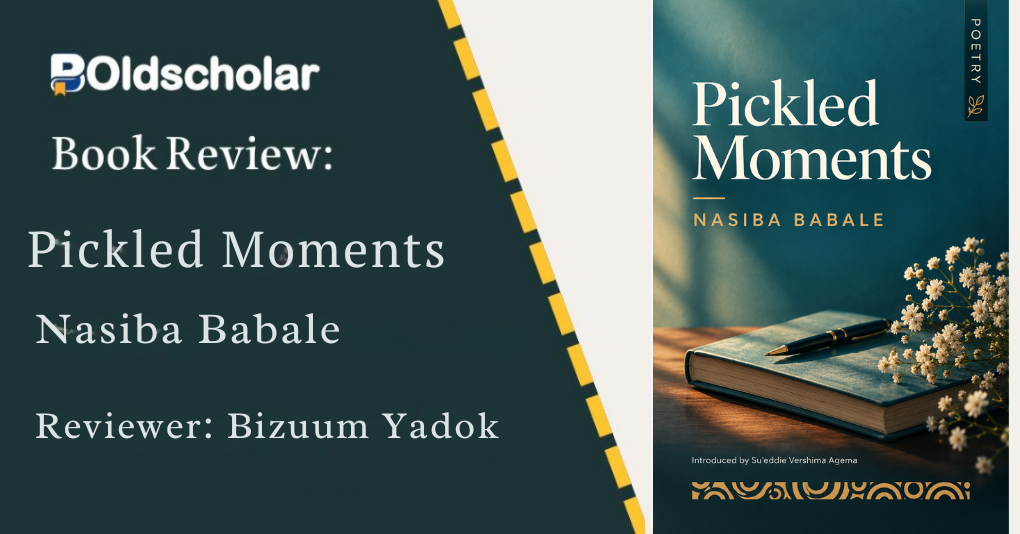
Notable Nigerian poet and literary critic, Moses Tsenongo, once remarked that poetry should not play hard-to-get nor overtly court its readers; instead it should find a balance to meet its reader. Nasiba Babale’s debut poetry collection, Pickled Moments, aptly fits the aforesaid prescription. Once a work of poetry is completed, its interpretation lies in public domain and its distribution may hardly exceed its first print if the poetry does not appeal to the reading public. Babale’s poetry, however, comes with a promise owing to the accessibility of ideas therein.
Like in most poetry collections, the poems are of varied themes and styles but Babale goes an extra mile by neatly tying poems with related subject-matters into different segments. Accordingly, the collection is divided into six major parts of varying lengths titled: “Why not Love?”, “The Price of a Homeland”, “This is Not a Home. This is Not a Country”, “This is Me”, “Pickled Moments”, and “A Buffet of Loss”. I would like to believe that segments are carefully arranged to flow like a river from the hill to the valley. The poems in “Pickled moments” are endearing but the poems in “Why not Love?” and “This is Me” stand out for me.
The very first poem ushers the reader to Babale’s world of poetry where he is wont to keep saying “wow” as he glides through the pages. “Deserted”, as the poem is titled, goes:
He says that I am a poet
So I will always have words
But there are no words in me
I struggle to say them beneath
The weight of his gaze . . . (P. 1, Ls. 1-4)
These words capture the intensity of love which robs the persona of her consciousness, numbing all the words that ordinarily should have helped her maintain her sanity. Thus, she admits that love could cause one’s mind to feel deserted and as such the poet becomes vulnerable as it is described in the concluding lines of the poem:
What power do words have
Where love rules?
Where do words go
When a poet falls in love? (P.1, Ls. 11-14)
The poem ends with rhetorical questions which double as cliff hangers. Herein lies one of the strengths of Babale’s poetics – the ending of her poems. She crafts them in such a way that will keep her reader thinking while at the same time establishing a link between the title and the ending. To buttress this point, the opening poem in the section, “This is Me”, titled, “How I Wear my Accent” says in its last two stanzas that:
Let the world laugh at my accent,
I am what I am,
I am a daughter of the North,
I learned my mother’s language in her womb,
And its marks were ingrained on my tongue
Long before I learned the foreign language
So here I am,
Wraffed in all za shades op my accent,
Wondering weza ip I sfeak wiz all za wads in za right flaces,
Will I cease to be a Hausa Girl? (P.74, Ls. 25-34)
The bold assertion and proud embrace of the identity of the author’s surrogate concisely explains, in the words of the author, “How I wear my Accent.” In most parts of the world, accent is innocently used as indicator of the attitude one gets from ‘others’. For the northerners in Nigeria, especially those of Hausa origin, their accent is unjustifiably – even illogically – used against them. The stereotype is perhaps informed by the headstart that the southern region had in terms of acquiring Western education. The poem evokes Hafsat Abdullahi’s poem, “To the Girl in English Class” and it speaks about resistance to an imposed identity, a postcolonial phenomenon. The poet makes it clear that having one’s mother tongue superimposed on her second language, in this case English, is nothing to apologize for and it does not, using any conceivable yardstick, measure intellect.
Closely related to accent is the issue of skin colour, which ordinarily should not be a problem in Nigeria but it is, especially among women. The quest for the light skin has led to a lucrative enterprise for those in the cosmetic industry. Again, the poet offers no apology for being black and wearing a dark shade of skin. The point is expressly made in the poem, “Poet of Light”, where the poet says:
I hear them whisper,
She is black,
Like the midnight of a moonless night after a heavy storm
Her head is still buried in the sands of old.
Who wears black skin in a world that settles with fear? (P. 83, Ls. 1-5)
It seems as though those who prize fair skins over dark skins have a tendency to be more racist than white supremacists if their race was altered. But like Maya Angelou or Nina Simone, the persona radiates light from her melanin and in the concluding lines she poignantly remarks:
I am black, ‘
I am light,
I am the radiance of poetry,
And I am the poet of light. (P. 84, Ls. 33-36)
Once again, the poet affirms, as she has done in many other poems, her freedom from winding in the maze of insecurity that bedevils many others. The ‘lyrical “I”’ in the poem, as in the others, anaphorically reminds readers of the relationship between the poet and her alter ego.
A good poet usually stands on the shoulders of greater poets to find her path to greatness. Here, Babale pays tribute to her inspirers in poems crafted after them. For some, she cites excerpts of their poetry as vignettes for her collection. Among them is Kahlil Gibran, whose quote says, “Love knows not its depth until the hour of separation.” Others include Marhmoud Darwish, Tyler Knott Gregson, Nizar Qabbani, Charles Bukowski, Mosab Abu Toha, Ba Sabouke, Umar Sidi and others. The collection is beautifully introduced by Su’eddie Vershima Agema although I think that there ought to be an advisory for the reader to read the introduction after reading the poems or that the introduction, which functions as a spoiler to me, should have been placed at the end but then it won’t be an introduction if it’s occurring at the end.
I also wonder how the poet overlooks Nigeria and fixes more of her gaze on Gaza, when Kano’s neighbours like Katsina, Zamfara, and Borno are steeped in violent conflict. In any case, injustice in a part of the world is injustice all over the world but then charity begins at home. Nasiba Babale’s Pickled Moments is people’s poetry; it is both relatable and understandable, navigating both private and public spaces seamlessly. She is definitely a poet to look out for.
Bizuum Yadok
Bizuum Yadok is a teacher, poet, critic, and literary administrator.
He can be reached via [email protected]
Share this post

Be the first to comment on this post