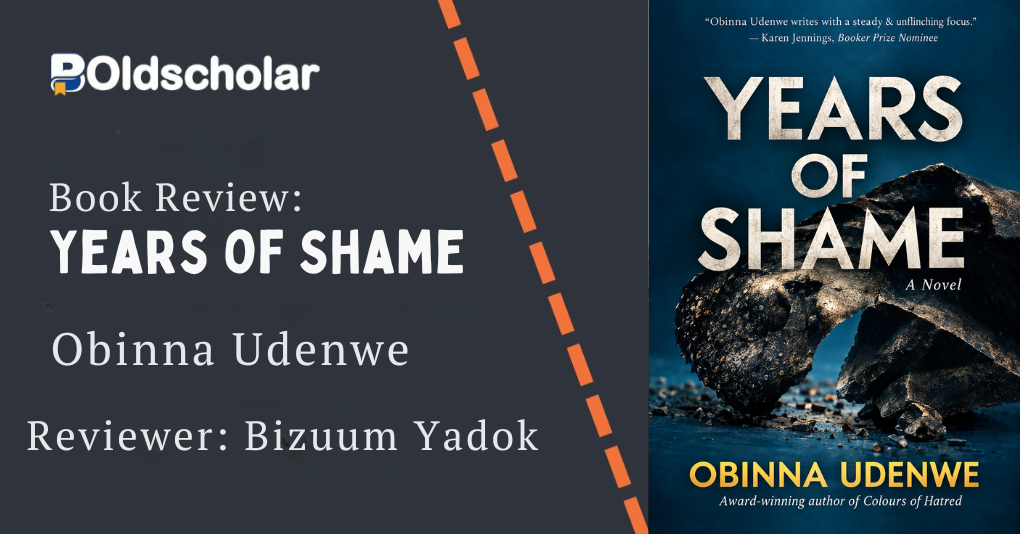
More often than not, Nigerians fear taking oaths by traditional deities than by the Bible or Qur’an which most of them claim to believe. This is hinged on the fact that most oaths administered before native deities are accompanied by dire consequences. I would like to believe that Nigeria would have been a saner place if oaths of office were taken in the presence of deities like Sango, Amadioha, or Kyetser, who would eagerly pounce on every oath taker who flouts the rules of engagement. This is because folk histories are replete with examples of people who dared the gods by swearing oaths that resulted in their misfortune. Though fictionalized, one of such instances can be found Obinna Udenwe’s Years of Shame.
The dreaded ukpa ji-ukpa nwa oath among the Abakaliki people of Ebonyi swings its wrath at either the plaintiff or defendant depending whose side guilt rests. The lifetime consequence of the said oath leads to loss of wealth and even children. Years of Shame begins in medias res when its tragic protagonist, Patrice Ikebe returns from taking the ukpa ji-ukpa nwa upon the conviction that one of his loyal boys, Methuselah Enigwe, stole a huge sum of money from him. Against all cautionary statements, Patrice drags the accused to swear the oath. Hitherto, Patrice Ikebe enjoys prominence as the wealthiest son of the village even though he ranks as the manager to Sir Douglas Akidi, a person of immense power and wealth. However, things start falling apart for Patrice Ikebe from February of 1976 after taking the oath. He loses his wife who returns to her parents’ house and then loses the job which gives him the prestige in his village. His only son dies soon afterwards and Patrice finds himself swimming in poverty. In the meantime, word of mouth goes that Methuselah is also wallowing in poverty somewhere far away from the village. Patrice then gets a new lease of life when his cousin, Oforbuike, drops a large amount of money into his palms and urges him to go back to the city in order to bounce back as the wealthy man they had always known. In company of his daughter, Suzanne, Patrice arrives Abakaliki and is eventually re-employed by Chief Douglas Akidi, the Ibini Ukpabi 1 of Aro Oke-Igbo. As an Aro man, Sir Douglas Akidi despises the Abakalikis who are referred to, derogatorily, by the Aros as “Wawa”. Yet, Akidi’s fatal flaw, his unbridled libido, pulls him from his high horse into bed with fourteen year-old Suzanne. Chief Akidi already has three wives – Ekwutosi, Ijeoma, and Irene – and many children, who all reside in his mansion but his clandestine sexual affair with the young teenage leads to a pregnancy which makes Patrice Ikebe to go berserk. To spoil the book a little more for you, Suzanne gives birth to an exact replica of Chief Douglas Akidi and the boy is named, Kosarachi. Now this is just the beginning so whoever reads the entire novel will know how the events unfold.
It is imperative to note that the story is steeped in historical events mostly around the Ebonyi area dating from the 1940s up to the first decade of the twenty-first century. This also includes the era of the Aro or Eru hegemony in Abakaliki and the resistance of the oppressed people, notably the Izii Revolt of 1969 which took place under the cover of the Nigerian Civil War. Since then, it had been a continuous journey of emancipation for the Abakaliki’s, I believe, until the creation of Ebonyi State in 1996. Interestingly, Udenwe’s story doesn’t only expose the dichotomy between the Aro and the Izii people which is fed by the stereotype created by the former, it shows how both variants of the Igbo nation freely interrelate in the present Nigerian setting.
Of pertinence is the role Patrice Ikebe’s conflict agency in the novel. He is not just a tragic character but also a symbolic character. His name, Patrice, when split into two syllables would give ‘Pat’ and ‘rice’. Rice becomes important to us, here, because its production is a major source of income for the Abakaliki people. Patrice himself has always been obsessed with rice business – its cultivation, processing, and distribution – as his ticket to abundant wealth. Indeed, Abakaliki variety of rice is highly sought after on account of its swelling when cooked. This brings us to another part of Patrice; that which causes rice to swell when cooked or parboiled but in his case it is called PRIDE. Pride was Patrice’s undoing; it led him to brag about being the manager whom Sir Douglas Akidi, he thought, couldn’t do without; pride goaded him to take the ukpa ji-ukpa nwa oath; and, annoyingly, the same pride prevented him from seeking redemption. Therefore, pride ushered him into his years of shame, the shame which did not spare even his offspring.
Whoever reads Years of Shame must respect the author’s narration and character development with particular reference to Douglas Akidi, Patrice Ikebe, and Irene. The crisscrossing of events in the text by the instrumentation of flashback and foreshadowing makes the narrative all the more appealing, not to mention the twists in the racy plotline. Unlike other African writers of English expression, Udenwe brings the Igbo language at par with English, consciously unbending all Igbo expressions in the novel and not also bothering to translate any Igbo vocabulary produced by code-switching in dialogues of the characters. Still, the non-Igbo reader is not denied the juice of the story. The publisher should also take credit for the exquisite design and reader-friendliness of the book. I found the author’s note to be an overkill for the textual backdrop even though it is located at the end of the book. Some events had very little connection to the plot stream and Patrice’s fling with Nneoma, Ijeoma’s sister, is one of them. The printer’s devilry also manifested infinitesimally. Regardless, Obinna Udenwe’s Years of Shame is book that will certainly outlive its peers as it will ignite more conversations about politics, ethnicism, potency of autochthonous traditions, history, and gender discourse. It is hardly possible for a single review to do justice to the book. Coming from an author with years of experience and multiple awards, Years of Shame bears witness to the literary profundity of some young Nigerian writers among whom Obinna Udenwe stands tall.
Bizuum Yadok
Bizuum Yadok is a teacher, creative writer, literary administrator and a literary critic. He can be contacted via [email protected]
Share this post



Be the first to comment on this post