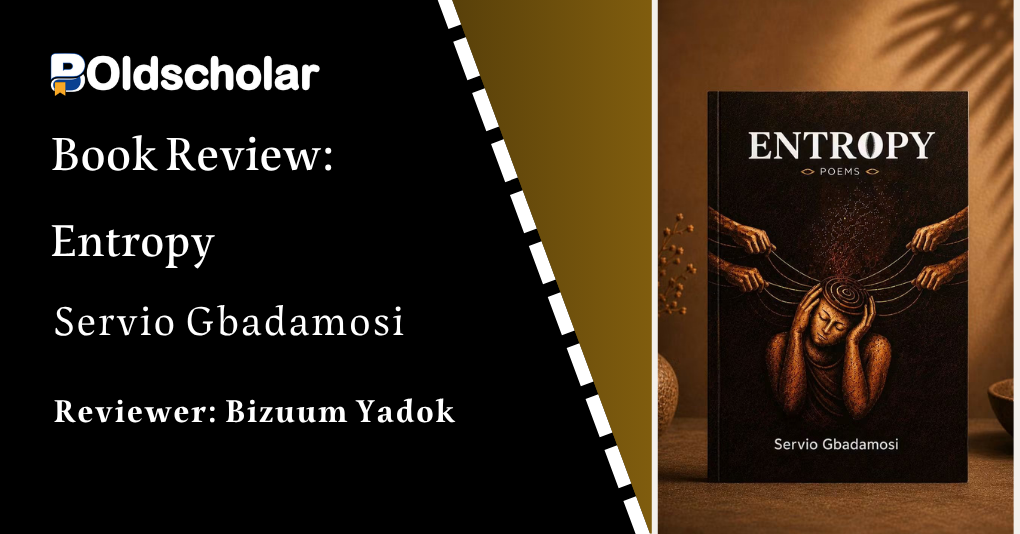
A Review of Servio Gbadamosi's ENTROPY by Bizuum Yadok

The saying, ‘still waters run deep’, comes to mind when one explores Servio Gbadamosi’s third poetry collection, Entropy.
Sep. 9th 2026
A Review of Servio Gbadamosi's ENTROPY by Bizuum Yadok


LOSS, PARTIAL RESTORATION, AND ALL ELSE IN-BETWEEN 

The saying, ‘still waters run deep’, comes to mind when one explores Servio Gbadamosi’s third poetry collection, Entropy. This is because the poet crafts his poetry collection in a texture that would feel soft and smooth if the words were palpable, yet it bears an abysmal depth. Here, he establishes life through four phases – Order, Unravelling, Decay, and Reordering – of the mind where life’s meaning(lessness) is fathomed. 

The first poem, “I return to you,” is laced with several allusions mostly referring to Iconic Nigerians or things. In the opening he says, “I return to you, Okigbo/I return to you, Mother Itodo” (Ls. 1&2) more like returning to one of the landmarks of Nigerian poetry but this returning signals a quest for renewal or perhaps restoration for he says: 

I return to you

for the ritual bath – 

for another attempt 

at cleansing 

this camwood of guilt, 

this chameleon of faeces

the Niger scrubbed 

into my broken body (Ls. 9-16)


“Niger” in the except above is a metaphor for Nigeria or those negative practices ascribed to the Nigerian mentality. Ironically, the Niger river does not wash him instead it scrubs chameleon faeces into his body. The poem ends on a sarcastically pessimistic note as the persona remarks of himself thus: “A Eunuch/shivering in prayer/on his wedding night” (Ls. 61-63). The poet’s lament in the succeeding poem, “Questions for Godot,” arise from questions posed to the persona who lacks the answers but pushes them to Samuel Beckette’s Godot, assuming that is God himself. He indicates that in the anxiety of planning and attempting to pattern life, man forgets to savour the moments as they come as he declaims: 

A man should not have to wonder

every single day

why he is doing this thing called life;

why he is trapped

in this cesspool of 

shit and sunshine

looping endlessly (Ls 37-43).


The metapoetics of the third poem, “When the poem mounts me,” insists that poetry is not obliged to take a moral direction especially when the poem rides the poet. In a related poem, “A covenant of knowing,” the poet goads poets to seek more knowledge, peeling away all layers of sentiments so as to stand with humanity as he declares that “The poet must name both–/not to judge/but to know/what it costs/to stay human”(Ls 32-36). 

The poet displays a great deal of awareness about the local and global activities surrounding him in the second segment of the poem, “Unravelling”. For example, in the poem, “The world is going to war,” the poet speaks of the vulnerability of third-world people in war that would be fought by blood-thirsty politicians and billionaires which could lead to the extinction of certain people and certain environments. “The sky above Gaza” further conveys the aforesaid sentiment and “A dirge from the streets of Lagos” does not deviate from that path well – the awareness of the hurt and the dying. One of the most profound poems in this section is “How the world controls us,” where the poet expresses mankind’s perpetual tethering to invented narratives about power, obedience and submission precipitated by fear as buttressed in the first and last stanza’s of the poem: 

Fear is the swaddle

we are wrapped in at birth, 

the air we breathe as we 

stumble through life,

the silence that closes

our eyes at death

. . .

Fear is how the world controls us. 

It is not only the thing done to us, 

It is the thing we do to ourselves (Ls 1-6 & 24-26)


The poem, “June ending,” an elegiac immortalization of Richard Ugochukwu Ayah, ushers the reader to the third segment of the collection, “Decay,” which houses more melancholic poems starting with “Bye-bye, November.” Here, the poet paints a vivid picture of losing his father to death in a more narrative than poetic articulation.  The gloomy emptiness of life and living are further captured in the poems, “We all fade into darkness,” “The way of all flesh,” and “What happens before nothing.” Like the philosopher in the Ecclesiastes in the Bible, the poet iterates the vanity of life and man’s endless ambitious pursuit. This is succinctly underscored in the last stanza of “What happens before nothing,” where the poet states: 

Through laughter and tears,

grace and punishment, 

the strange drama of existence

in which we dance 

at the bright start

or numb end of life, 

we come to the realization 

that we are nothing

before, and even after, 

nothing. (Ls. 40-49)


Tragedy rings through most of the collection and particularly the third section and this is informed by losses of individuals and collective losses. The poems, “What the West still calls our country,” “A brief history of the Niger river,” and “The marriage of king and clown” embody national tragedy, laments on loss of values and of common sense. Without mincing words, he adds, in the opening stanza of “The poem as a testament of loss” that, “No one writes the tragedy/that is our country/better than her poets.” Maybe this quite explains the flirtation of, mostly, Nigerian poets with anger and sadness over personal and national losses in the myriad threnodies that define modern Nigerian poetry across several generations. 

Moving on does not entail a total restoration but the willingness to stitch up wounds and live with whatever could be termed the new normal. At least that is what Haruki Mukarami implies in the epigraph that opens the last segment, “Reordering,” and it is at this point that Entropy as a phenomenon makes more sense. The illustration that accompanies the section is also very helpful in that it further drives home the point. In “Three reflections of fatherhood,” the poet declares: 

I have become

the water lettuce,

the water lily,

I crown the waters

that once troubled me. 

I have become the jewel

of the rivers that give joy

to the sea (Lines 47-54).


It is without doubt that the stated transformation enables the poet to cope, to become, to live, and to enjoy in spite of every odd. Thus, in the succeeding poems, “An invocation to fruitfulness,” “The heart remembers how to heal,” “The Laughter of children” and “We refuse to give up on love” tells of life in different resilient forms. 

On the whole, the volume of poetry speaks of Gbadamosi’s expertise in the field of poetry and it is a charming invitation for all to enjoy poetry. Still, the keen reader is not denied of rich symbolisms, alluring metaphors, and native sagacity. In spite of the fact that a few of the poems appear to have the same content but different forms, I would still rate the collection as one of my best reads for the year and of all time. Its Osundarean cadence portends that poetry needs not to be gaudy in order to be embraced and deemed relevant but that its profundity can still be gauged even in crystal waters. Entropy is unarguably a masterpiece that should sit comfortably on the shelf of every poetry connoisseur. 

Bizuum Yadok


Share this post

0 Comment

    Be the first to comment on this post

Leave a comment

More Blog Posts
Image Jul 29th. 2026

Review of Eziwho Emenike Azunwo's The Ring

Book Title: The RingAuthor: Dr. Eziwho Emenike AzunwoReviewer: Chiorlu NdidiPublisher......

Continue Reading

Image Jul 27th. 2026

A Review of Azunwo Eziwho Emenike's Worst Case Scenario

 Book Title:                       ......

Continue Reading

Image Jul 24th. 2026

Review of Eziwho Emenike Azunwo Ekwain Mkpe

  Book Title: Ekwan - Мкре(An Adaptation of Adi Wall's Tears of the Bereaved)Author: Dr. E......

Continue Reading

Image Jul 23rd. 2026

Review of Eziwho Emenike Azunwo's "The Last Resort"

 Book Title: The Last Resort Author: Dr. Eziwho Emenike Azunwo Reviewer: Origbenba Go......

Continue Reading

--> A Review of Servio Gbadamosi's ENTROPY by Bizuum Yadok - Boldscholar News

A Review of Servio Gbadamosi's ENTROPY by Bizuum Yadok

The saying, ‘still waters run deep’, comes to mind when one explores Servio Gbadamosi’s third poetry collection, Entropy.
Sep. 9th 2026
A Review of Servio Gbadamosi's ENTROPY by Bizuum Yadok


LOSS, PARTIAL RESTORATION, AND ALL ELSE IN-BETWEEN 

The saying, ‘still waters run deep’, comes to mind when one explores Servio Gbadamosi’s third poetry collection, Entropy. This is because the poet crafts his poetry collection in a texture that would feel soft and smooth if the words were palpable, yet it bears an abysmal depth. Here, he establishes life through four phases – Order, Unravelling, Decay, and Reordering – of the mind where life’s meaning(lessness) is fathomed. 

The first poem, “I return to you,” is laced with several allusions mostly referring to Iconic Nigerians or things. In the opening he says, “I return to you, Okigbo/I return to you, Mother Itodo” (Ls. 1&2) more like returning to one of the landmarks of Nigerian poetry but this returning signals a quest for renewal or perhaps restoration for he says: 

I return to you

for the ritual bath – 

for another attempt 

at cleansing 

this camwood of guilt, 

this chameleon of faeces

the Niger scrubbed 

into my broken body (Ls. 9-16)


“Niger” in the except above is a metaphor for Nigeria or those negative practices ascribed to the Nigerian mentality. Ironically, the Niger river does not wash him instead it scrubs chameleon faeces into his body. The poem ends on a sarcastically pessimistic note as the persona remarks of himself thus: “A Eunuch/shivering in prayer/on his wedding night” (Ls. 61-63). The poet’s lament in the succeeding poem, “Questions for Godot,” arise from questions posed to the persona who lacks the answers but pushes them to Samuel Beckette’s Godot, assuming that is God himself. He indicates that in the anxiety of planning and attempting to pattern life, man forgets to savour the moments as they come as he declaims: 

A man should not have to wonder

every single day

why he is doing this thing called life;

why he is trapped

in this cesspool of 

shit and sunshine

looping endlessly (Ls 37-43).


The metapoetics of the third poem, “When the poem mounts me,” insists that poetry is not obliged to take a moral direction especially when the poem rides the poet. In a related poem, “A covenant of knowing,” the poet goads poets to seek more knowledge, peeling away all layers of sentiments so as to stand with humanity as he declares that “The poet must name both–/not to judge/but to know/what it costs/to stay human”(Ls 32-36). 

The poet displays a great deal of awareness about the local and global activities surrounding him in the second segment of the poem, “Unravelling”. For example, in the poem, “The world is going to war,” the poet speaks of the vulnerability of third-world people in war that would be fought by blood-thirsty politicians and billionaires which could lead to the extinction of certain people and certain environments. “The sky above Gaza” further conveys the aforesaid sentiment and “A dirge from the streets of Lagos” does not deviate from that path well – the awareness of the hurt and the dying. One of the most profound poems in this section is “How the world controls us,” where the poet expresses mankind’s perpetual tethering to invented narratives about power, obedience and submission precipitated by fear as buttressed in the first and last stanza’s of the poem: 

Fear is the swaddle

we are wrapped in at birth, 

the air we breathe as we 

stumble through life,

the silence that closes

our eyes at death

. . .

Fear is how the world controls us. 

It is not only the thing done to us, 

It is the thing we do to ourselves (Ls 1-6 & 24-26)


The poem, “June ending,” an elegiac immortalization of Richard Ugochukwu Ayah, ushers the reader to the third segment of the collection, “Decay,” which houses more melancholic poems starting with “Bye-bye, November.” Here, the poet paints a vivid picture of losing his father to death in a more narrative than poetic articulation.  The gloomy emptiness of life and living are further captured in the poems, “We all fade into darkness,” “The way of all flesh,” and “What happens before nothing.” Like the philosopher in the Ecclesiastes in the Bible, the poet iterates the vanity of life and man’s endless ambitious pursuit. This is succinctly underscored in the last stanza of “What happens before nothing,” where the poet states: 

Through laughter and tears,

grace and punishment, 

the strange drama of existence

in which we dance 

at the bright start

or numb end of life, 

we come to the realization 

that we are nothing

before, and even after, 

nothing. (Ls. 40-49)


Tragedy rings through most of the collection and particularly the third section and this is informed by losses of individuals and collective losses. The poems, “What the West still calls our country,” “A brief history of the Niger river,” and “The marriage of king and clown” embody national tragedy, laments on loss of values and of common sense. Without mincing words, he adds, in the opening stanza of “The poem as a testament of loss” that, “No one writes the tragedy/that is our country/better than her poets.” Maybe this quite explains the flirtation of, mostly, Nigerian poets with anger and sadness over personal and national losses in the myriad threnodies that define modern Nigerian poetry across several generations. 

Moving on does not entail a total restoration but the willingness to stitch up wounds and live with whatever could be termed the new normal. At least that is what Haruki Mukarami implies in the epigraph that opens the last segment, “Reordering,” and it is at this point that Entropy as a phenomenon makes more sense. The illustration that accompanies the section is also very helpful in that it further drives home the point. In “Three reflections of fatherhood,” the poet declares: 

I have become

the water lettuce,

the water lily,

I crown the waters

that once troubled me. 

I have become the jewel

of the rivers that give joy

to the sea (Lines 47-54).


It is without doubt that the stated transformation enables the poet to cope, to become, to live, and to enjoy in spite of every odd. Thus, in the succeeding poems, “An invocation to fruitfulness,” “The heart remembers how to heal,” “The Laughter of children” and “We refuse to give up on love” tells of life in different resilient forms. 

On the whole, the volume of poetry speaks of Gbadamosi’s expertise in the field of poetry and it is a charming invitation for all to enjoy poetry. Still, the keen reader is not denied of rich symbolisms, alluring metaphors, and native sagacity. In spite of the fact that a few of the poems appear to have the same content but different forms, I would still rate the collection as one of my best reads for the year and of all time. Its Osundarean cadence portends that poetry needs not to be gaudy in order to be embraced and deemed relevant but that its profundity can still be gauged even in crystal waters. Entropy is unarguably a masterpiece that should sit comfortably on the shelf of every poetry connoisseur. 

Bizuum Yadok


Share this post
0 Comment

    Be the first to comment on this post

Leave a comment

More Blog Posts
Image Jul 29th. 2026

Review of Eziwho Emenike Azunwo's The Ring

Book Title: The RingAuthor: Dr. Eziwho Emenike AzunwoReviewer: Chiorlu NdidiPublisher......

Continue Reading

Image Jul 27th. 2026

A Review of Azunwo Eziwho Emenike's Worst Case Scenario

 Book Title:                       ......

Continue Reading

Image Jul 24th. 2026

Review of Eziwho Emenike Azunwo Ekwain Mkpe

  Book Title: Ekwan - Мкре(An Adaptation of Adi Wall's Tears of the Bereaved)Author: Dr. E......

Continue Reading

Image Jul 23rd. 2026

Review of Eziwho Emenike Azunwo's "The Last Resort"

 Book Title: The Last Resort Author: Dr. Eziwho Emenike Azunwo Reviewer: Origbenba Go......

Continue Reading

-->