It is apparent that digital technology is rapidly compelling humans to employ it for communication, commerce, transport, and nearly every human endeavor. The present era of globalization has further equipped more people with platforms in the new media, also known as social media, to express themselves to a virtual audience; instigating action, change, and, sometimes, rebellion. There is no way of denying the role of social media’s agency in the evolution of mankind or the redrafting of policies, laws, or even organizations.
The Arab Spring of 2012 was further catalyzed by the social media, which witnessed massive revolts leading to the ousting of unpopular governments around some parts of North Africa and the Arab peninsula. We may also make reference to how millions of hashtag impressions informed reforms in America and Nigeria through the #BlackLivesMatter and #EndSARS respectively. In view of the potency of the social media to disrupt organizations and public life, many governments have fashioned the necessity to enact laws that will control their citizens’ use of the various social media platforms. The platforms themselves have set up internal regulatory frameworks aimed at controlling the use of the new media thus making it a safe space for all to use. To this end, one’s social media account could be suspended or banned altogether if such a person violates agreement terms – by sharing illicit content for instance – or is reported by another person for some awkward reason.
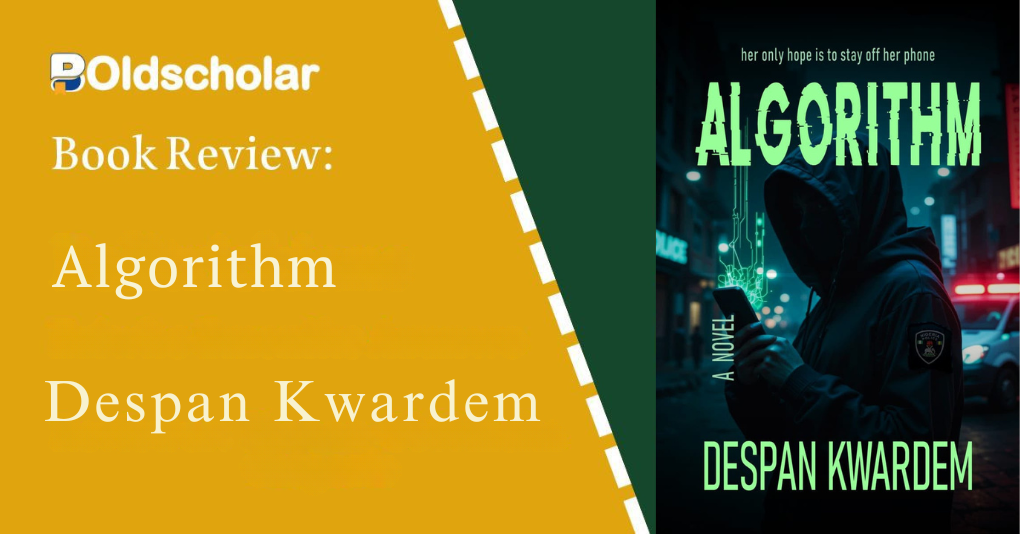
What if countries, through the help of AI, create social media police to detect threats to civility and social existence thereby preventing breakdown of law and order? Well, in an alternate futuristic reality in Nigeria, Despan Kwardem presents a scenario of the possibility of a digital technology control mechanism that is set in Nigeria in the year 2031 via his sophomore novel, Algorithm. Algorithm has everything to do with programming according to patterns. In Kwardem’s Algorithm we meet Musa, a Deputy Superintendent of Police working with a newly established arm of the police known as Social Media Algorithm Police (SOMAPOL), a unit of police that he had also participated in its programming from the scratch. By design, SOMAPOL identifies every citizen who has digital footprints and zooms in its focus on citizens of particular interest (especially deviant citizens) by their activities on social media. Accordingly, by its Social Credit Score (SCS) system, it tries to control human behavior by awarding credits for compliance with conventions and reducing credits from individuals whose behavior, whether online or offline, is unacceptable. At first, Musa and his team at SOMAPOL, including Cynthia, Donatus, and Commander Gbenga, are pleased with the algorithm’s efficacy, one of which successfully leads to the tracking and arrest of Tunji Dolapo – a notorious social media critic of the government.
It doesn’t take long for Musa to start questioning the acclaimed objectiveness of the SOMAPOL algorithm considering how it keeps taking away credits from his crush, Doris. Meanwhile, Doris has a long history of social media activism and that behaviour of hers inserts him in a dilemma because his loyalty his torn between his commitment to SOMAPOL and his attraction to her. Unknown to him, however, Cynthia, one of his colleagues, who is erotically passionate about him, also feeds the algorithm with commands which constantly spotlight Doris as an errant citizen. Cynthia aims to take Doris out of the way because she is mad over Musa and makes no pretense about it but Musa’s mumu button is already pressed for Doris so he finds himself breaking standard protocol to save her. However, Musa is oblivious of the fact that he was also being watched and reported to his Commander courtesy of Donatus’ betrayal on account of the attention he (Donatus) was not receiving from Cynthia because Cynthia’s mind is focused Musa. In a subplot, Doris’ cousin, Yaks, who is desperate for medical attention for his father, teams up with other children of retired police officers who were needing urgent medical aid and they kidnap the Director of Pensions at the Police Headquarters. They later release him after hacking into his account to sort out their financial needs as well as many of those whose parents’ entitlements had not been paid. Doris is made to nurse her uncle in India and upon her return gets arrested for cybercrimes and being linked to the kidnappers’ alleged crimes owing to her digital footprints and familial relationship with one of the boys. If Doris will be eventually tried and found guilty or otherwise, it will depend on the reader’s determination to reach the last page of the book.
Beyond the thrill of the scintillating plotline is the discourse on social media regulation or control, some of which occur perniciously. The introduction of the Social Credit Score (SCS) is an overkill on what is supposedly the casual use of the social media, making the environment unsafe for proper expression of human rights. As Doris SCS plummets, she encounters challenges in seeking social services or even renting an apartment to the extent that she is forced to squat with her friend, Gina. It would take Zara, Gina’s cousin and a runaway SOMAPOL trainee, to open the eyes of Musa to the overreaching punitive tentacles of SOMAPOL’s algorithm as seen in the excerpt below:
She tapped her finger on a heavily redacted file stamped: “EYE-OF-GOD INITIATIVE: CLASSIFIED – LEVEL BLACK/ SECTION NINE CLEARANCE REQUIRED.” Musa scanned the lines. Key words leaped out at him, “Neuromodulation. Algorithmic feedback loops. Population model destabilization risk. Subject: Anomaly.” “They aren’t just watching people,” Zara said quietly, “They’re . . . modifying them” (P.238).
A little while later, Musa digs up buried data, some more, and finds disturbing evidence, “A field: “Transaction auto-suspended pending Trust Score Verification.” He clicked. A profile came up – just a regular man from Kogi State. No priors. No activist trail. But his trust score had tanked. Reason: “Persistent engagement with encrypted group chats sharing religious content” (P.243).
It is evident from the foregoing that the algorithm is programmed to do more than surveillance, it actually subtly controls behavior of the citizens by determining what one should do or say and whom they ought to associate with. This is because there is always someone at the backend who dictates the workings of the seemingly unbiased algorithm. Therefore, in the long run, a good number of people will fall victim not on account of their actions but their inactions. Another of such instances is when Cynthia, after reviewing a footage of heated argument between Tega, a conscientious journalist, and Musa, impulsively decides to pull the algorithm’s claws closer to her crush’s provoker with the tag: “Override Threat Protocol: New Target – Tega Ben Terwase. Tag: Potential Adversary to Asset Falcon (Protective Priority Level 2). Sub tag: Ideological Corrosive/Surveillance Required” (P. 77). In way, SOMAPOL actually works like the stereotyped Nigeria Police Force and the Judiciary – whose victims are always the powerless or the unconnected.
Speaking of the Nigeria Police Force, the author makes no effort to transform their popular reputation in Nigeria, typically that which thrives on connection and corruption even though story has a futuristic setting. Assistant Police Commissioner Awosika, for example, who is Director of the Police Pensions Board siphons retired Officers’ gratuities to his account from where he dishes our substantial shares to the Inspector General of Police and another part travels to the President’s account as well. Nonetheless, characters like Musa and Madam Oche are representative figures of integrity and loyalty in service. They also offer the humane angle of the force. It is interesting to note that Madam Oche and Doris share an intriguing relationship which, again, is left for the reader to discover.
Also noteworthy is that the novel has a faith-based under-tone yet nowhere does the reader find the name of Jesus or the Bible screaming in the body of the work. The presence of Pastor Siman Manzo, a local pastor in a rural area, illuminates Musa’s suspicion about the algorithm. Manzo assures him that the entire algorithm is a reliable framework for the control of the anti-Christ in the last days as prophesied in Revelation. His catch phrase, which Musa regurgitates is, “No man may buy or sell without the mark of the beast.” He makes Musa to understand that recording of biodata through digital technology may be a way of one’s submission and, with a questionable loyalty, one could get blacklisted such that he may not be able to buy nor sell. Musa is shocked to find the same words explicitly written in “Seal 9: No man may buy or sell . . . “ (P.245). Looking at how we volunteer information about ourselves and unconsciously spell out our tastes or mental disposition to the social media, it goes without saying that we are unconsciously being shepherded by the system which will ultimately dictate how one ought to or how not to behave on social media. Think about it, one who shares helpful or spiritual content on the internet, particularly in Nigeria, achieves low visibility or becomes shadow-banned but someone who shares sensual or controversial content gathers myriad engagements. Worse is that I know a number of people who get kicked out of Facebook, TikTok, Instagram, or Twitter for inexplicable reasons.
In terms of delivery technique, the writer deserves a thunderous applause for integrating the urban realism of Cyprian Ekwensi, the suspense-filled pattern of James Patterson, the sci-fi jargon of Isaac Asimov, the espionage-complex of Robert Ludlum, and the eschatological underpinnings of Jerry Jenkins. Yet, in all these, the reader feels the wheels of love driving the narrative, especially between Musa and Doris. The author must be commended for dialogues which fit an exciting movie. I wager that any successful movie adaptation of the novel will yield an Oscar or some prestigious movie award.
The novel is loaded with several characters, some of which exist as terminal nodes, functioning minimally in the text. Examples are CP Hadiza Bello, DIG Bulus Zoaka, and Gina. In spite of that, the reader enjoys the juice of the narrative, and may not even consider a downside. Kwardem’s Algorithm is a book that jerks you by the collar from the very start and pulls you into itself until you reach the last page, yearning for more.
If there is ever going to be an assembly of Nigerian science fiction or techno-thrillers, Kwardem’s Algorithim will be standing boldly in front because it is a totally original yet ingeniously crafted piece of art. It cogently confronts the intersection between science, art, and the numerous possibilities in-between. If I would have my way, I would make this book a must-read for all Nigerians. I am confident that in a short while this outstanding novel will gather prestigious literary prizes to the author and to itself.
Bizuum G. Yadok is a teacher, a creative writer, literary administrator, and literary critic. He is the winner of the Sevhage/E.E. Sule Prize for African Literary Criticism 2024. You can reach him via email – [email protected]
Share this post



Be the first to comment on this post