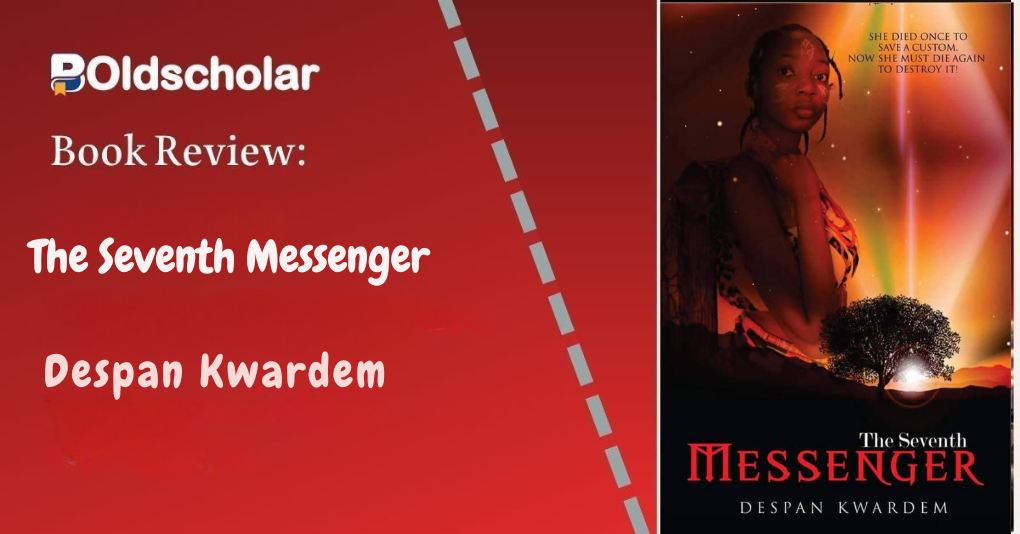
When a book is said to be a jealous book, she takes the form of Despan Kwardem’s The Seventh Messenger. Rightly described because she is a book that does not want to be shared with anything like popcorn or tea while being read. She is like a woman that pulls her man by the neck and holds him down till he is done with his exploration. The Seventh Messenger takes you down to the distant pre-colonial past somewhere in the heart of Nigeria where the West-Chadic languages were resting in the loins a prototype language, long before they evolved into what they have become today – Ngas, Mwaghavul, Goemai, Chip, Mupun, Mushere, and others.
There, we meet a teenage maiden by name Nankyer, who is chosen by the god, Arkum, to be sacrificed during the Ampidong Festival; a ritual of purification and rededication of the people of Jigoland carried out once in every seven years. That particular festival coincides with the ending of the seventh time cycle of the Jigo calendar. By Jigo calender, a time cycle amounts to seventy years and each time cycle had its renowned messenger appointed by Arkum. Previous time cycles produced Muda, Nok, Bhraima, Moshe, Samoa, and Shaya – all males- as messengers of Arkum and it is hoped that Nankyer’s sacrifice will catalyse the appointment of the seventh messenger. Therefore, Nankyer drinks the poisonous liquid and is thrown into the river after which other rites take place and, for a compensation, her mother will be crowned Nhin Kaam of Jigoland. However, the conflict sets in when Nankyer does not die and she is discovered in a comatose state by a woman named Satzen, who does not recognize her at first but is determined to restore her.
Meanwhile, a search party are on the lookout for her corpse for proper burial as a requisite for the mother’s coronation. While the coronation is stalled, mysterious events occur: A woman is attacked by a leopard which eventually kills one of the hunters; a boy, Nanle, nearly gets drowned in a shallow river; and the queen of Jigo, Naben, dies from the venom injected by the fangs of an enigmatic cobra. All accusing fingers point at young Nankyer, who is suddenly labelled a witch. In the brief period which Nankyer’s life leaves the earth, she meets Arkum who instructs her to inform the people of Jigo to stop all forms of human sacrifice. More to that, the chiefs discover that the girl bears the mark of Tambes, indicating that she is probably the seventh messenger. That the messenger could be a woman and that the first message calls for the abolition of human sacrifice riles Gwol, the Chief Warrior who is also a wizard. Gwol becomes determined to end Nankyer’s life by all means but the vulnerable Nankyer courts the protection of Tuwan, Satzen’s husband, who is also the son of Dadet, the Chief Hunter. Will Gwol succeed in his mission of terminating her life? Will she succeed in discovering the parchment in Dokpai that will prove she is the seventh messenger and further authenticate her message? Only the curious reader will find out.
The plot is full of unpredictable turns and twists with several episodic suspense. It brings the reader close to the ancient life of people of central Plateau with their traditional practices and religious rites such as koos paa (divination), puun (self-purification), and kum (rituals). The writer generously integrates aspects of nature – rocks, rivers, lakes, plants, and animals – into the life of the people of Jigo Kingdom. This fictitious representation of alternate history also features sorcery and transmogrification. Once adapted to the screen, the narrative will become an excellent epic.
In spite of the fact the author deep-dives into the past, he still retains some of humanity’s timeless universal values and virtues like bravery, hardwork, kindness, and forgiveness. In fact, the conscious reader hardly misses the influence of Christian orientation on the author owing to the moral inclination of the story. Also noteworthy about the novel is the fluidity of the narrative and the richness of the dialogues, most of which are laced with traditional motifs. However, one wonders how pidginized interrogative markers like ‘abi’ and nomenclatures like ‘Bingo’ (for a dog) slip away from the consciousness of the present to the past. A number of typos also managed to survive the proofreader’s scrutiny. Still, regardless of its length, the books holds her reader down until the last page.
Globally recognized Nigerian writer, Chimamanda Adichie once remarked that literature supplements a people’s history and even substitutes in the absence of history. This holds true to a large extent when one surveys the scanty scribal pre-colonial historical documents of the people of North-Central Nigeria, particularly that of Plateau. In this regards, one would see Kwardem’s The Seventh Messenger as a worthy contribution to Nigerian literature and even African literature as a whole. Through such a novel, the voice of the minorities is heard as it echoes from the past. This is one of the few books that I have read twice. By the way, Despan Kwardem’s second novel, Algorithm, is out. Look out for it.
Bizuum Yadok
Share this post




Be the first to comment on this post