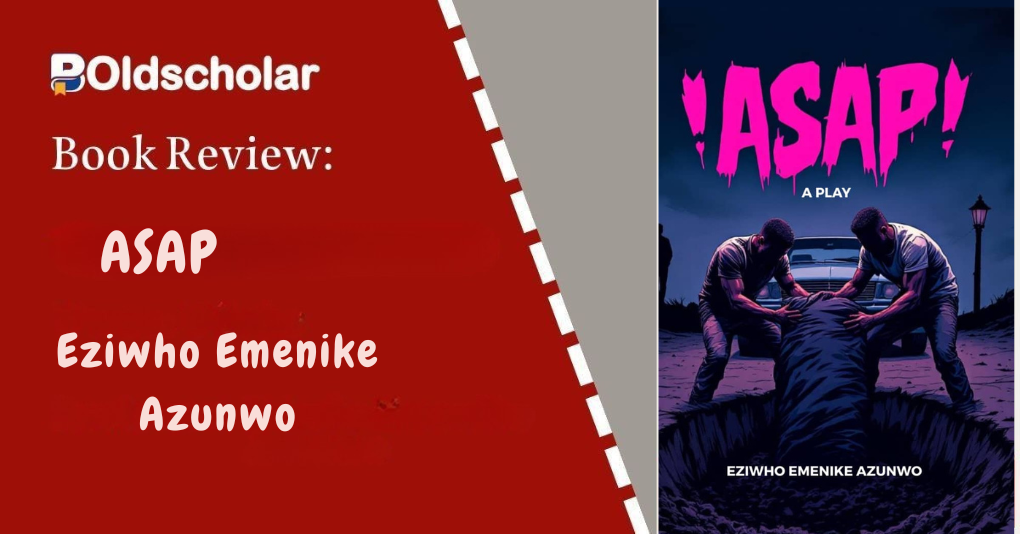
Author: Dr. Eziwho Emenike Azunwo
Reviewer: Chiorlu Ndidi
Genre: Drama
Publisher: Emu Integrated Services
Pagination (number of pages) 47 pages
Year of Publication: 2025
Institution: Rivers State University, Port Harcourt,
Department of Theatre and Film Studies.
INTRODUCTION
Eziwho Emenike Azunwo’s Asap (2025) emerges from a deep reflection on the troubling realities of our society, where desperation, unchecked ambition, and the temptation of quick wealth frequently blur moral judgment and lure ordinary individuals into irreversible decisions.
The get-rich-quick mentality that has permeated the lives of our Nigerian youths into doing the unthinkable, this has become subject of Azunwo, a well-known contemporary writer and academic with an exceptional corpus of socially conscious works. This play highlights the degree of desperation and the pursuit of rapid fortune. The play's title, ASAP, is symbolic because it criticizes the colloquial terms "quickly" and "immediately," since riches actually requires diligence, persistence, and constancy.
Using actual settings, everyday dialogue, and slangs to highlight the catastrophic effects of greed and wickedness of man to man, the idea itself of the popular get-rich-quick syndrome of today's Nigerian youth. Like many of Azunwo's plays, this one focus more on the moral and social responsibilities of playwrights and their works as a tool for social change, highlighting evils and its punishment, while praising good deed. This review provides a critical examination of the play, considering its themes, narrative structure, characters, style, and societal significance while situating it within the broader Nigeria and African dramatic problems.
Synopsis
ASAP opens on Dominic telling Awuse about his plan to make millions, he promises to give Awuse some millions too if the deal eventually works. Awuse eager and ready to make money inquires of Dominic the nature of the deal. Dominic had earlier thought of killing his uber driver, collect his car and sell, Awuse his brother agreed to his plan after hearing how much is involved. Dominic invites the uber driver and killed him with the help of Awuse. The incident took a toll on Dominic, he is worried about how to sell the car without any implication. Dominic and Awuse connects to a buyer, but couldn’t sell because of the amount he was priced, at this point Dominic has changed from is usual self as Alice his girlfriend tries to find out what the problem is. Dominic finally meets a police man who agrees to help him move the car to another sells point. Dominic and Awuse were later apprehended by the commissioner of police and his team.
Themes:
Get-rich Quick syndrome: The central theme of Asap is the get rich quick syndrome, Azunwo dramatizes how systemic the will to get rich quick, wickedness of man, and greed has dominated the world, even Nigeria. Dominic embodies present-day Nigeria youth, who can do anything to get rich not minding the consequences.
Evil conspiracy: Dominic and Awuse conspires to kill a man who sorts his daily bread through driving other people with his own car. The discussion between Dominic and Awuse shows how wicked and desperate Nigerian youths have become when it comes to making quick money. Dominic’s plot reflects his hardness of heart and Awuse’s acceptance also shows how evil communication can corrupt good manners.
Corrupt security agencies: The role of staff sergeant Okoro illustrates the corrupt practices amongst some police men and women of today. Sergeant Okoro’s acceptance to help Dominic and Awuse move the car to another community for sell, symbolizes how many of our force men are accomplice to killing and selling of cars of so many victims like the uber driver.
.
Characterization
Dominic: The central character, a young man driven by ambition and desperation whose choices lead to his downfall. A youth figure who is greedy and wicked, he is determine to make millions by killing an uber driver and sell his car. He refuses to sell the for a price he considers too small to make him kill another human.
Awuse: Dominic’s bother and friend loyal but impressionable he is drawn into Dominic scheme and struggles with guilt, lured into killing the uber driver for the purpose of making millions. His suggestions on how the uber driver should be killed makes him desperate in getting rich quick. He is seen as a hard guy, which could be the only reason Dominic could think of him to execute such a wicked mission. He followed Dominic fully in his crime.
Alice: Dominic’s girlfriend perceptive loving and morally grounded, she notices Dominic’s troubling behavior and represents the voice of conscience. Alice, embodies a good girl who pays attention to details of events, she quickly observes a change in Dominic behavior after killing the uber driver. She continues to question his strange behavior throughout her stay.
Davies: Dominic’s friend supportive and resourceful he helps Dominic make connection but is he unaware of the full extent of Dominic’s plans.
Driver: the unsuspecting victim of Doninic and Awuse’s plot. Innocent and trusting he becomes the tragic catalyst for the story conflict. He lives his house as usual to meet a client who happens to Dominic and never went back home.
Chile: Car buyer a sharp business minded character who negotiates the sale of the stolen car. Practical and observant. He follows Dominic and Awuse to inspect the car, found some faults and priced the based on its worth.
Young man: Assistant to the car buyers helps Dominic and Awuse connect with Chile and the car.
MEN1-4: group of car buyers skeptical and cautious representing the street level business and moral pragmatism of the market place.
Staff sergeant okoro: military officer loyal and trust worthy, he becomes Dominic’s secret helper in the risky plan embodying authority and street wise judgement.
Officers 1-2: law enforcement officers they apprehend Dominic and Awuse ensuring justice is served.
Narrator: offers moral analysis and comments throughout the performance. helps the listener comprehend the implications of the story.
Drummers: provides the auditory backdrop emphasizing tension mood and dramatic effect throughout the play.
Language and Style
Azunwo employs a blend of realist dialogue and heightened theatricality the scenes are marked by realistic everyday activities ranging from friendly discussions and execution of plans. The repeated breakdowns of Ademola into tears function both as character study and metaphor for a corrupt leadership class unable to take responsibility. The use of drumming and musical undertones punctuates scenes, connecting the play to African performance traditions while also heightening emotional tension. Stage directions are precise, ensuring that performances capture the realism and symbolic depth of the text.
Dramatic Techniques
The Discussion Realist: The discussion and plan between Dominic and Awuse scenes are grounded in realistic dialogue and action.
Set up as Structure: Dominic plan to get rich, provides the idea of killing the uber driver to make money, which led to his arrest.
Music/Drumming: Serves as emotional punctuation, connecting to traditional African dramaturgy.
Real-Life Scenario Commentary
ASAP is a realist play based on a true-life story, addressed real life issues, bothering on our present-day Nigeria’s youth attitude, on quick wealth, youths doing anything to get rich
The play resounded actual current situation associated with Nigerian youths, even teenagers dramatizing them in ways that force audiences to understand that there is a way that seems right unto a man, but the end thereof is destruction.
It also encourages of hard work, diligence, and consistency, echoes beyond killing and ritual hard work pays. By portraying Chile who serves his master, working in the mechanic workshop “Asap,” the play critiques a Nation where money speaks.
Comparative Perspective
Azunwo's ASAP is consistent with the traditions of Nigerian conscientization theater. It critiques societal dysfunction through tragedy, an inquiry, and symbolic characterizations. Asap highlights the importance of diligence, hard work, and consistency.
Weaknesses
prompt attention to urgent national issues from the institutional, societal, and domestic levels.
strong incorporation of African performance aesthetics (symbolism, drumming)
Even if Chile's tears are symbolic, they run the risk of becoming monotonous. Other characters, such as Alice, Davies, and Chile, are underdeveloped. The drama occasionally prioritizes message over intricacy, leaning toward didacticism. However, the play's advantages greatly exceed its disadvantages, making it a potent work of socially conscious drama. Also, the play did not end well, as the culprits were not apprehended.
Conclusion
ASAP by Eziwho Emenike Azunwo is a powerful, biting indictment on Nigeria's youth will to get rich quick and corruption on the side of security agencies. The play compels its audience to see the consequences of decision of Dominic by dramatizing the personal tragedies of Dominic and Awuse against the backdrop of lack of perseverance on the side our youths.
It carries on the Nigerian tradition of using drama as a mirror for society and as a call to reform as a piece of socially conscious theatre. Azunwo has created a play that is both contemporary and disquieting by exposing the so-called "Asap" ‘’immediately” dangerous. It serves as a dramatic reminder that every choice made in life has an impact on the lives of individual. I strongly recommend the play with the culprit, Dominic, Awuse and the Sergeant Okoro thrown behind bars.
Recommendation
The play while filled with moral lessons, did not end well. We did see Dominic and Awuse been punished for their which is the playwright’s intention. We will like Awuse and Dominic face the consequences of their wicked action.
Share this post



Be the first to comment on this post