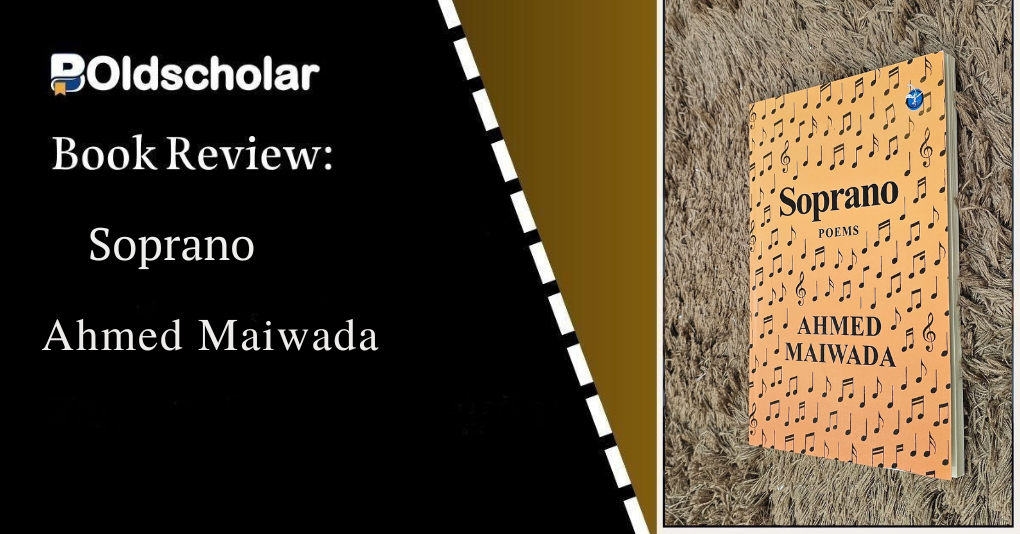
It is quite common for poets to nostalgically yearn for places they have lived in. However, it strikes differently when places summon poets or even argue over their ownership. Ahmed Maiwada’s Soprano presents the lengthy hearing of a case where a poet-persona finds his mind torn between two major cities in Nigeria, Zaria and Lagos, representing the ancient and modern; conservative and libertarian; monarchical and democratic; metaphorized as the “Queen” and the “Mermaid” respectively. In this poetic case, the Queen is the plaintiff and the Mermaid is the defendant. There is also the poet ‘himself’, the Frog, and the Judge, all of them singing different tunes in the high-pitched soprano.
This singular poem of five parts also appears like several poems connected by the thread of the case yet the voices of all the several personas are distinctly heard and their tones unmistakable as well. While a critical reader may be tempted to interpret Soprano independent of the author’s background – considering its modernist mould, partly informed by the poem’s style and allusion to modernist poets like Ezra Pound and e.e. cummings –, a proper grasp would pay attention to the poet’s background being that he was initially bred in Zaria before migrating to Lagos and then to other major cities in Nigeria. Therefore, in a way, the poem bears the semblance of an autobiographical narrative. However, fixing one’s eye on the reality may rob one of the entertainment offered by the case personified by the cities in argumentative interlocution over a talented poet. For example, in the first part titled, “The Case against the Mermaid”, an excerpt goes:
. . .Thus says the Queen:
Smash!
Silence, sponsoring us pain, smash!
Burn!
Die!
Mermaid, downing the poet (P. 3, lines 12-17)
The Queen’s venous tongue is glaring in her wish for a torturous death unto the Mermaid for “downing” her “poet”. Her poet is not dead but stripped down of her features meant to be engraved in his craft for she says, in a separate segment that, “My poet is out there/With none of my tableland anywhere/Nor my silk cotton trees/To sit his strand of thought, for a chair. . .” (P. 5, lines 16-19). The Queen continuous to reel out a chain of lamentations and accusations against the Mermaid, the poet, and the Frog. In this first part of the poem, memory is portrayed as a bridge which connects the past (time and place) with the present mindset of the poet. The loss of the bridge worries her the most for she declares:
The poet took his bridge with him
When crossing the bridge at Lokoja,
Over the Niger and the Benue.
His host, the mermaid on the coast
Ceased and burned it (P. 9, lines 5-9)
It is pertinent to note that the Mermaid is not the only accused person here because the second part of the poem, “The Case against The Frog” advances the Queen’s tirade albeit from third person’s voice, where it is said, “The Queen calls you Age/She calls you Rust, also:/ . . . But, here, your name is the The Ripper” (P. 21, lines 11, 12, and 21). The Queen views the Frog, time, paradoxically, as both “Age” and “Rust” and later becomes more comfortable with its alias as the “The Ripper”, hence, the repetitive use of the word in succeeding pages of the text. This third person also showcases the Queen as no stranger to defeat as he recalls a historical antecedence:
Zaria, Amina’s blood;
Sister of framed cities, Sheba of the Sahel,
A conquered handmaid,
Zaria, the capital south of the Ocean of Dust (P. 24, lines 8-11)
It is the finesse with which Maiwada weaves his poetry that leaves the reader awestruck. His resourceful imagery blends well with the reality of everyday life in either Zaria or Lagos. Thus, in the third part of the poem titled, “I Sing Life”, the poet persona celebrates his freedom within the seductive embrace of the mermaid but still cautions that too much of everything, conservatism or libertinism, is bad as he remarks: “Light./Darkness./Each, in a solid state/ quashes seeing” (P. 31, lines 23-26). This profound statement admits the danger of extremes of binary opposites and, in a way, calls for a balance. Accordingly, the poet struggles to relieve himself of the highhandedness of Zaria’s memory while trying not to submerge himself completely under the semi-chaotic atmosphere of Lagos. Therefore he surrenders his life to the chance in Lagos as seen in the following lines:
And, Life here is a Ludo game
. . .
Lives are lived
by the dice, serving,
being and dying
by chance alone (P. 36, lines 4 and 16-19)
This perhaps explains the truest nature of Lagos which is often perceived as city of opportunities but despite one’s relentless hardwork or smartness, the rolling dice of Lagos determines who eventually prospers or not. Still, the poet’s eyes capture all the fleeting moments in both cities including the seemingly trivial ones with precision as could be gleaned in the excerpt below:
The hay pillows on the animals ‘backs
were the shock absorbers lacking
in the molue seat here in the city:
Hardwoods in frames of hardsteel
Driven across pockmarked roads,
bringing the bones of men
to many tears. (P. 39, lines 17-23)
The fourth part, aptly titled, “The Arguments” weighs the claims of both The Queen and the poet while juggling puns and biblical allusions specifically calling attention to the “Rainbow”, even though ambiguously, as a precursor to the judgement that would be delivered in the fifth part of the poem titled, “The Verdict”. Thus, the last part is ushered in by a traditional Hausa poem that likely suggests the influence of oral tradition on the art of the author. The Judge in this last part of the poem emphasizes his determination to remain objective in spite of the complexity of the case:
Yes, the strands are tangled,
Like the strands in a big hair
In a caking savannah pond mud;
But I, the judgment seat, shall pursue
And overcome (P. 89, lines 21-25)
Having paid attention to the cases and having gauged the veracity of the facts, the Judge declares that:
I find Lagos with the Queen’s gold in hand.
I find that the city, uninvited
To her own defence,
Shall receive silence in return.
Yes, I find,
In this climate change,
When luxury goes up in smoke,
Heaven ‘fire must be hoped for
In return. (P. 104, lines 1-9)
Thus, the Queen is blamed instead and rightly so because her poet ran away from her increasing poverty and bigoted mindset, not to mention the avalanche of violent slaughters on grounds of religion or ethnicity. The poet persona also receives his share of the blame for abandoning the Queen all along. As such, in the very last segment, titled, “The Last Words”, the Judge states:
Here are the commands for the parties
In this court present,
For the small town first, and then for the poet;
But none for the city,
Kaduna or Lagos.
No orders for the Frog, (P. 105, lines 1-6)
Soprano explores the interconnection between an artist and his environment, migration and memory, and time and space. The lengthy poem traverses the northern and southern parts of Nigeria and all the problems therein in a flowery language that compels the reader to mull over the lines in a manner that invokes respect for the poet. The spoiler which wore the garment of the “Publisher’s Note” subtracts the open-minded reader’s experience upfront. Every poem or collection should be able to communicate with its reader without the assistance of an introductory note and even if there must be such a note it should come at the end of the poem. There is also a little problem with the translation of the Hausa traditional poem found in page 79 where a part says, “Zaki, bari/Damisa, bari” translated as “Lion, stop it/Tiger, stop it”. I believe that the word Damisa is meant to be leopard or some endemic African cat and not the Asian Tiger. However, these few observations have quite very little to do with the fluidity and superb delivery of Ahmed Maiwada’s poetry. Having read a few of his poetry collections including this one, I make bold to say that Ahmed Maiwada is one of Nigeria’s finest poetic talents. Soprano alone should be able to convince you. Even though Soprano’s Frog begs me to go, I will leave you with a last excerpt from pages 109-110 of the poem which goes:
And, there shall be an after-party
On the graves of dead hostilities
Here on dry land, just emptied
Of its consuming floodwater (lines 29-30 & 1-2)
Kindly make of it whatever you will. I am off to another poetry collection.
Bizuum G. Yadok
Share this post




Be the first to comment on this post