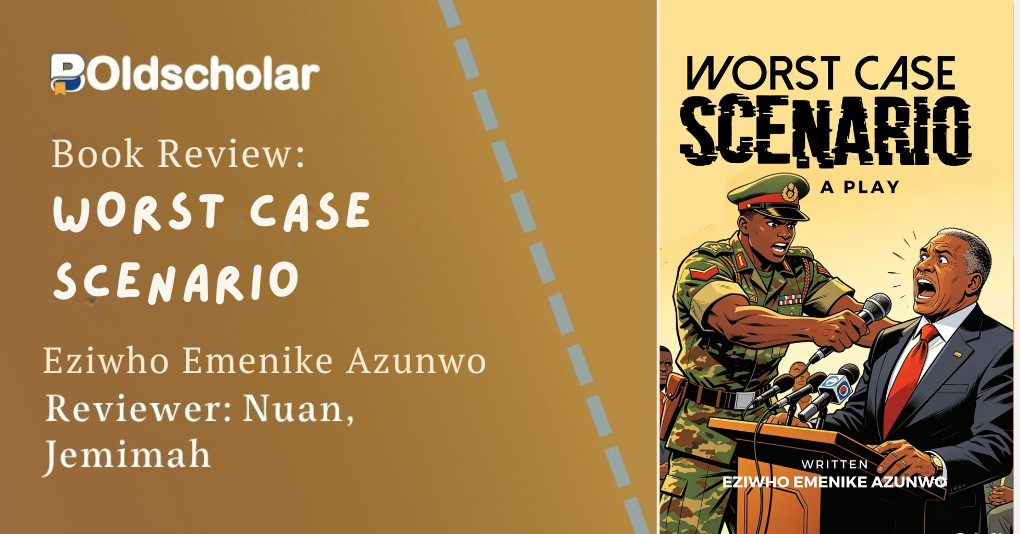
Book Title: Worst Case Scenario
Genre: Drama
Author: Dr. Azunwo, Eziwho Emenike
Reviewer: Nuan, Jemimah
Pagination: 11 pages
Year of Publication: 2026
Institution: Rivers State University, Port Harcourt
Department: Theatre and Film Studies.
Introduction
Worst Case Scenario is a contemporary political drama by Eziwho Emenike Azunwo that interrogates the realities of governance, political ambition, power struggle, leadership, insecurity, electoral politics, patriotism and the uncertainty surrounding democratic transitions in Africa, particularly Nigeria. Through seven interconnected scenes, Azunwo presents a nation trapped between failed leadership, desperate politicians, and a frustrated populace whose hope continually shifts from one political actor to another before ending in the shocking collapse of democracy through a military coup.
Rather than only telling a political story, the playwright constructs a philosophical conversation about power. Although primarily a political drama, the play also incorporates elements of tragedy, satire, and social realism, making it both entertaining and intellectually stimulating. The title itself, Worst Case Scenario, functions as a warning that when democratic institutions fail, the unimaginable may eventually become reality.
Justification Of The Title
The title Worst Case Scenario aptly captures the central message of the play and foreshadows its tragic outcome. Throughout the drama, political leaders engage in power struggles, electoral calculations, and ideological conflicts while ignoring the deeper problems confronting the nation. As democratic institutions become increasingly weakened by insecurity, corruption, selfish ambition, and ineffective governance, the nation gradually moves toward an avoidable catastrophe. The military coup that abruptly interrupts the President's nationwide broadcast represents the ultimate "worst-case scenario," bringing democratic rule to an end. Thus, the title serves as both a warning and a reflection on the devastating consequences that arise when political leaders place personal interests above national development and fail to uphold democratic values.
Genre
Worst Case Scenario is predominantly a political drama because its plot revolves around political campaigns, leadership struggles, governance, electoral strategies, and the contest for state power. The play examines the ambitions, ideologies, and rivalries of political actors while exposing the realities of democratic politics.
The play also contains elements of tragedy, as the democratic system collapses unexpectedly through a military coup, destroying the hopes invested in the electoral process. Similarly, it functions as a satirical drama by mocking political arrogance, empty campaign promises, and the hypocrisy of many political leaders. Furthermore, its realistic portrayal of corruption, insecurity, poverty, and public frustration places it within the tradition of social realist drama.
Plot Structure
The play follows a linear plot with a clear cause-and-effect relationship.
Exposition
The opening scene introduces Honourable Udoka, an experienced politician living under constant fear despite his wealth and political influence. His conversation with Tony immediately introduces the central issue of the coming election and the uncertainty surrounding Nigeria's political future.
The audience is equally introduced to a society where fear has become normal.
Rising Action
The dramatic tension increases through successive meetings involving different political actors.
The audience witnesses:
Babayega's ambition.
Felix's idealism.
The President's overconfidence.
Secret political negotiations.
Intelligence gathering.
Political distrust.
The failure of coalition talks.
Every scene gradually raises expectations about an electoral showdown.
Climax
The climax of Worst Case Scenario occurs during the President's nationwide press conference, when the audience expects him to reassure the nation and strengthen public confidence ahead of the election. Instead, the broadcast is violently interrupted by armed soldiers led by General Kobo, who arrests the President, suspends the Constitution, dissolves all democratic institutions, and declares military rule. This shocking reversal completely overturns the audience's expectations and transforms the political narrative from an electoral contest into the collapse of constitutional democracy. Although Felix's rejection of Babayega's coalition proposal marks a significant turning point by eliminating the possibility of a united opposition, it is the unexpected military coup that serves as the dramatic peak of the play. The scene delivers the full meaning of the title, Worst Case Scenario, illustrating the devastating consequences of failed leadership, political division, and weak democratic institutions.
Falling Action
General Kobo immediately justifies the military takeover by pointing to insecurity, corruption, hopelessness and failed governance.
Instead of celebrating the coup, he presents it as the unavoidable consequence of political failure.
Resolution
The resolution deliberately avoids a conventional happy ending. Instead, the play concludes with an open-ended reflection on national responsibility, leaving audiences to question whether democracy can survive without accountable leadership and active citizenship.
The playwright successfully sustains suspense throughout the play by delaying the ultimate crisis until the closing scenes.
Characterization
Characterization is one of the strongest aspects of the play. Each major character represents a distinct political ideology and contributes significantly to the development of the central conflict.
Honourable Udoka serves as the experienced political elder whose wisdom is reflected in his frequent use of proverbs and philosophical reflections. Although wealthy and influential, he lives in constant fear, symbolized by the cutlass he carries for protection. His cautious attitude illustrates the insecurity that pervades both politics and society.
Tony functions as the dramatic link connecting the different political camps. He serves as a loyal political aide whose movements between characters enable the audience to understand the unfolding political landscape. Although he possesses intelligence and political awareness, his role remains largely supportive rather than independent.
Babayega represents political ambition, strategy, and pragmatism. His emphasis on coalition building and electoral calculations portrays him as an experienced politician who believes political success depends on tactical alliances rather than emotional idealism. His proposal that Felix should become his running mate demonstrates both political intelligence and personal ambition.
Felix serves as the moral centre of the play. Unlike the other politicians, he consistently emphasizes hope, servant leadership, accountability, and national development. His refusal to compromise his principles by accepting Babayega's proposal highlights his ideological consistency and commitment to public trust. Felix symbolizes the possibility of ethical leadership in a corrupt political environment.
The President embodies the arrogance often associated with entrenched political power. He dismisses public dissatisfaction, underestimates his opponents, and believes his victory is guaranteed. His excessive confidence eventually contributes to his downfall, making him a tragic political figure.
Although General Kobo appears only in the final scene, his entrance completely transforms the direction of the play. He represents authoritarian intervention and becomes the embodiment of the consequences of failed democratic governance. His speech reflects the frustration of a nation overwhelmed by insecurity, poverty, and political disappointment.
Themes
Failure of Leadership
The dominant theme of Worst Case Scenario is the failure of leadership. Throughout the play, different political figures present contrasting approaches to leadership, yet none successfully provides the direction needed to rescue the nation. The President relies on power and political authority while ignoring the suffering of the people. Babayega believes political strategy, alliances, and calculations are the keys to national transformation. Felix, on the other hand, represents integrity, accountability, and people-oriented leadership, insisting that governance should restore hope rather than serve personal ambition. Honourable Udoka contributes another perspective by emphasizing caution and political experience. Despite these differing ideologies, the democratic system eventually collapses under a military coup, suggesting that leadership failure is not limited to one individual but reflects the failure of the entire political culture.
Political Ambition and the Struggle for Power
Another major theme is political ambition and the struggle for power. Almost every significant conversation revolves around elections, political alliances, campaign strategies, and the selection of running mates. Babayega's attempt to persuade Felix into a political alliance demonstrates how politicians often seek power through negotiation and coalition building. The play exposes politics as a contest for authority in which ambition frequently overshadows genuine service to the people.
Ethical Leadership and Public Responsibility
Another important theme is ethical leadership and public responsibility. Through Felix's character, the playwright presents leadership as a moral obligation rooted in accountability, transparency, and service to the people. Felix consistently refuses to sacrifice his principles for political advantage, suggesting that effective governance requires integrity rather than political manipulation.
Hope versus National Disillusionment
The play also explores the tension between hope and national disillusionment. Felix symbolizes hope for national renewal and repeatedly promises responsible governance, while the President continues to reassure citizens despite worsening conditions. General Kobo's final speech reflects a nation exhausted by insecurity, poverty, broken promises, and political instability. The contrast between hope and reality reveals the disappointment experienced by citizens who have repeatedly trusted political leaders without meaningful change.
Fear and Insecurity
Fear dominates both the private and public lives of the characters. Honourable Udoka's reluctance to open his door despite having security personnel illustrates the widespread atmosphere of insecurity. Politicians constantly monitor one another, intelligence gathering becomes part of political strategy, and suspicion influences decision-making throughout the play. Ultimately, the military coup confirms that insecurity has spread from individuals to the entire nation.
Democratic Fragility and Institutional Collapse
The play demonstrates how democratic institutions become vulnerable when they are weakened by corruption, political selfishness, and ineffective governance. Rather than strengthening democracy through accountability and credible leadership, politicians become preoccupied with electoral victory and personal interests. The military coup symbolizes the complete breakdown of democratic governance and serves as the inevitable consequence of institutional failure.
Conflict
Several layers of conflict operate simultaneously.
There is political conflict between the ruling government and the opposition parties struggling to gain power.
There is ideological conflict between Felix's vision of ethical leadership and Babayega's strategic political approach.
The play also presents psychological conflict within individual characters. Honourable Udoka struggles between courage and fear in an increasingly insecure society, while the President's excessive confidence blinds him to the growing dissatisfaction of the people and the threat to his administration.
In addition, there is social conflict between the suffering masses and a political class that appears disconnected from their realities.
Finally, the military coup introduces institutional conflict, representing the struggle between civilian democracy and military authority.
Language and Style
The playwright employs simple, accessible language enriched with Nigerian English, Pidgin English, indigenous expressions, proverbs, metaphors, rhetorical questions, and repetition. This linguistic mixture creates authenticity and firmly situates the play within a Nigerian socio-political context.
Dialogue serves not merely as conversation but also as a medium for philosophical reflection and political debate. Through extended conversations, characters reveal their values, ambitions, and ideological differences.
The extensive use of African proverbs reflects the richness of oral tradition while adding depth to characterization, particularly in Honourable Udoka's speeches. However, some dialogues become excessively philosophical and lengthy, occasionally slowing the dramatic pace.
Dramatic Techniques
Azunwo employs a variety of dramatic techniques to sustain audience interest and reinforce the play's central themes. Dialogue serves as the primary vehicle for characterization, ideological conflict, and plot development, allowing characters to express their political philosophies and competing visions of leadership. Suspense is carefully maintained through confidential political meetings, intelligence reports, delayed revelations, and uncertain negotiations, all of which build anticipation toward the play's shocking conclusion.
Foreshadowing appears throughout the play, particularly in Honourable Udoka's constant fear, the recurring discussions of insecurity, political instability, and public dissatisfaction, all of which subtly prepare the audience for the eventual collapse of democratic rule. Dramatic irony is one of the playwright's most effective devices, as the President repeatedly boasts that the election is already secured, only to be arrested moments later during a military coup.
The playwright also employs symbolism, political satire, proverbs, monologues, repetition, and the ideological contrast between Felix's idealism and Babayega's political pragmatism to deepen the dramatic impact. In addition, the recurring use of drummers between scenes functions symbolically, heightening emotional tension, marking transitions between significant dramatic moments, and preparing the audience for each new stage of the political crisis. Together, these dramatic techniques strengthen the theatrical experience while reinforcing the play's exploration of leadership, power, and the fragility of democracy.
Stagecraft
Stagecraft is one of the strongest artistic qualities of Worst Case Scenario. The playwright effectively employs detailed stage directions, soft drumming, lighting transitions, symbolic entrances, carefully designed settings, strategic pauses, and moments of silence to sustain dramatic tension and enhance audience engagement.
The recurring drummers function almost like a Greek chorus, not by speaking but by preparing the audience emotionally for each dramatic development. Their rhythmic accompaniment heightens suspense, signals transitions, and reinforces the emotional atmosphere of the play. Similarly, the lighting transitions clearly separate scenes and emphasize changes in mood, while the shifting locations, ranging from private residences and political offices to conference rooms and media spaces, create visual variety and reinforce the political setting of the drama.
Symbolism
The playwright employs several recurring symbols to reinforce the central themes of the play.
The Cutlass
Honourable Udoka's cutlass symbolizes insecurity and the collapse of public safety. Despite his wealth, political influence, and security personnel, he still relies on a traditional weapon for self-defence, reflecting the citizens' loss of confidence in state security.
The Drums
The recurring drums symbolize the emotional heartbeat of the nation. They announce moments of tension, anticipation, celebration, and transition, while also reflecting the changing political climate throughout the play.
The Closed Door
The repeatedly guarded and carefully opened doors symbolize distrust, fear, and political uncertainty. They reflect a society where even influential leaders cannot freely trust those around them, emphasizing the breakdown of social and political confidence.
The Press Conference
The President's televised address symbolizes democracy's attempt to reassure the people. Its abrupt interruption by the military signifies the sudden collapse of democratic governance.
The Military Coup
The military coup represents the "worst-case scenario" envisioned by the playwright. It symbolizes the inevitable consequence of failed leadership, weak democratic institutions, and prolonged political instability.
Setting
The play is set in politically significant locations, including private residences, government offices, political headquarters, meeting rooms, conference halls, and media spaces. These settings reinforce the atmosphere of political negotiation, secrecy, and competition while demonstrating that decisions made behind closed doors eventually determine the fate of an entire nation.
Strengths
The play possesses numerous strengths. It effectively mirrors contemporary African political realities without limiting itself to one particular nation. The dialogue is intellectually engaging and appropriate for stage performance. The ideological contrast between Babayega and Felix creates compelling dramatic conflict, while the symbolic use of drumming, silence, and stage movement enriches the theatrical experience.
The characterization is generally convincing, especially the contrast between experienced politicians, idealistic reformers, and authoritarian figures. Furthermore, the ending is highly theatrical and memorable because the unexpected military coup completely overturns audience expectations. Above all, the play encourages civic reflection by prompting audiences to examine the consequences of poor leadership, political manipulation, and weak democratic institutions.
Weaknesses
Female characters receive minimal dramatic attention, making the play largely male dominated.
The military coup occurs suddenly, leaving little opportunity to explore its long-term consequences.
Overall Evaluation
Worst Case Scenario is a thoughtful and politically engaged drama that examines the fragile nature of democracy and the dangers of poor governance. Rather than presenting heroes and villains in simple terms, the playwright explores different philosophies of leadership through contrasting political figures. The shocking ending challenges audiences to reflect on the consequences of political complacency, failed institutions, and misplaced public trust.
Although the play occasionally sacrifices dramatic pace for extended political discourse, its thematic depth, symbolic richness, and relevance to contemporary Nigerian politics make it a significant contribution to modern African political theatre.
Conclusion
Eziwho Emenike Azunwo's Worst Case Scenario is ultimately less about a military coup than about the chain of political, institutional, and leadership failures that makes such a coup conceivable. Through its exploration of leadership, democracy, political ambition, corruption, insecurity, and national responsibility, the play demonstrates that when politicians prioritize personal interests above public welfare, democratic institutions become increasingly vulnerable.
The play argues that democracy cannot survive on campaign promises, political strategy, or personal ambition alone. Rather, it depends on accountable leadership, public trust, ethical political participation, and institutions strong enough to withstand moments of national crisis. By ending with the phrase "Worst Case Scenario," the playwright leaves the audience with a sobering reminder that the collapse of democracy is not inevitable, but it becomes increasingly likely when leaders and citizens fail to learn from history. Consequently, Worst Case Scenario stands as a compelling work of contemporary Nigerian political theatre that not only entertains but also educates, challenges, and provokes meaningful reflection on governance, citizenship, and the future of democratic society.
Share this post


Be the first to comment on this post