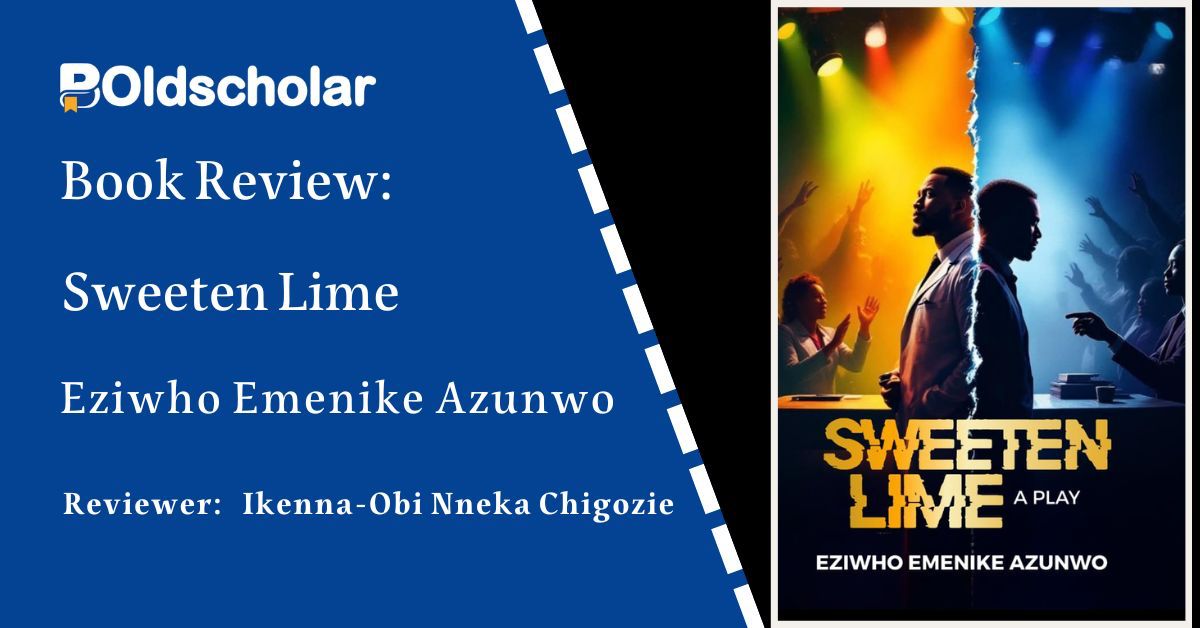
Book Title: Sweeten Lime
Genre: Drama
Author: Eziwho Emenike Azunwo
Year of Publication: 2026
Publisher: Covenant Daystar Publishers, Port Harcourt. Nigeria
Pagination: (Number of pages) 85 pages
Reviewer: Ikenna-Obi Nneka Chigozie
Institution: Rivers State University, Port Harcourt, Department of Theatre and Film Studies
ABSTRACT
Sweeten Lime portrays leadership as an unstable ethical landscape where individual aspiration is locked in continuous struggle with collective obligation. Located within the tense environment of an institutional electoral contest, the drama reveals how delicate the foundations of trust can be and how rapidly moral assurances may erode when confronted with opportunity. Azunwo creates a dramatic world in which triumph carries hidden stains and the climb toward authority gradually alters the inner lives of those pursuing it. Through persuasive rhetoric, strategic irony, and revelations of concealed bargains, the playwright traces a psychological journey that begins with courtship, moves through compromise, arrives at success, and ends in guarded suspicion.
At the heart of the play is a triangular tension among Dr. Uche, Dr. Amibo, and Okenna. Each figure illustrates a distinct approach to leadership and to survival within organized systems. Dr. Uche represents idealistic reform. His legitimacy is anchored in reputation, professional respect, and faith in the natural alliance between merit and advancement. To his followers, he appears as a restorative agent, someone capable of renewing a damaged institution and reinstating fairness. Nevertheless, Azunwo gently interrogates this optimism by asking whether admiration alone can resist calculated political maneuvering. Uche’s downfall stems not from corruption but from misplaced confidence; he equates being favored with being protected.
Opposed to him is Dr. Amibo, a practitioner of strategic realism. He interprets power as negotiation and views allegiance as something that can be transferred, priced, and redirected. Instead of challenging Uche’s public popularity, he searches for vulnerabilities within the rival camp. He finds that vulnerability in Okenna, a staff member whose hunger for relevance makes him receptive to recognition and promise. Amibo’s effectiveness lies beyond simple bribery; he carefully magnifies Okenna’s importance until cooperation feels inevitable. By wrapping inducement in grand language about legacy and transformation, he disguises manipulation as partnership and ambition as shared destiny.
Okenna’s gradual shift from hesitation to consent provides the emotional backbone of the narrative. He is constructed as an ordinary man, suspended between moral expectation and material desire. Pressured by economic realities, influenced by friendship, and tempted by advancement, he becomes a mirror of familiar human frailty. His exchanges with Nwala demonstrate how easily collective values can be replaced by pragmatic reasoning. Treachery begins to resemble wisdom; loyalty begins to appear naïve. When Okenna continues to energize Uche’s supporters while secretly aligning with Amibo, he inhabits a perilous duality. He acts devotion while pursuing escape. Through this split, Azunwo comments on institutional cultures that reward performance more than sincerity.
The voting sequence serves as the drama’s moment of eruption. The loud certainty of Uche’s camp collapses when results favor Amibo. Azunwo here contrasts visible excitement with hidden calculation, reminding the audience that democracy often conceals private negotiations behind public unity. The outcome is procedurally valid yet morally complicated. Celebration erupts, but it is shadowed by knowledge of how the ground shifted.
Yet the most penetrating commentary unfolds after the applause. When Okenna approaches the new leader to claim the pledged reward, Amibo declines. His justification is chilling in its clarity: the individual who abandons one loyalty may abandon another. In that instant, politics turns inward and devours its collaborator. The very act that elevated Okenna now disqualifies him. Amibo’s refusal may appear ruthless, but it follows the logic of self-preservation; authority cannot comfortably embrace proven betrayal. Victory therefore transforms into anxiety, and usefulness expires the moment power is secured.
The play does not confine its critique to public space. It also acknowledges the intimate sacrifices attached to aspiration. Uche’s strained domestic encounter reveals the emotional vacuum created by relentless commitment to institutional goals. Even honorable ambition produces neglect. By including this dimension, Azunwo resists romantic portrayals of virtue and instead presents leadership as a field of unavoidable trade-offs.
In the final analysis, Sweeten Lime proposes that systems governed by exchange rather than principle cannot escape instability. Those at the summit must remain wary, allies remain temporary, and unity remains fragile. Once integrity becomes negotiable, restoration proves difficult. Through the disappointment of Uche, the humiliation of Okenna, and the cautious success of Amibo, the playwright encourages reflection on a disturbing paradox: attaining office through compromise may deliver authority, but it rarely delivers calm.
Thus, the play extends beyond its immediate institutional frame to interrogate contemporary notions of governance and ambition. It suggests that what tastes sweet in the moment may ferment into bitterness later, and that elevation achieved through distortion grants prominence without security. Height exposes; it does not always protect.
SYNOPSIS
The institution buzzed with anticipation. A new Director-General was to be elected, and the stakes were high. Staff whispered in corridors, departments held discreet meetings, and alliances formed and dissolved with astonishing speed. At the center of the storm were two contenders whose contrasting qualities defined the possibilities for the institution’s future. On one side was Dr. Uche, a figure universally respected for his integrity, competence, and vision. His achievements were celebrated openly, and his approachable demeanor made him a favorite among staff at every level. People spoke of him not only as a leader who could advance the institution’s mission but also as someone who embodied fairness and principle. On the other side stood Dr. Amibo, a political tactician of rare skill. Clever, calculating, and unflinchingly ambitious, he had built networks of influence over decades, learning to turn circumstance and human weakness to his advantage. Where Uche inspired loyalty through admiration, Amibo demanded it through calculation and strategy.
Among the many influencers within the institution, Okenna stood out. Charismatic, persuasive, and deeply entrenched in the staff’s confidence, he held sway over countless votes and opinions. Both candidates recognized that winning Okenna’s allegiance could tilt the scales decisively. Dr. Amibo, ever the strategist, reached out privately. In a quiet, unremarkable office away from prying eyes, he laid out a deal that was simple and alluring: Okenna’s support in the election in exchange for promotions, financial incentives, and future opportunities of influence. The offer appealed to ambition and temptation alike. Though Okenna valued loyalty and had publicly championed Uche’s candidacy, the proposition stirred conflicting impulses within him. In the end, the pragmatic side of Okenna—the side that calculated risk and reward—accepted Amibo’s deal in secret while maintaining the appearance of unwavering support for Uche in public forums.
Campaign season intensified. Posters, speeches, and informal gatherings filled the institution with fervor. Uche’s supporters, unaware of the silent betrayal, spoke passionately of fairness, change, and a brighter future under his leadership. Confidence ran high. Staff believed that the votes were secured, certain that integrity would prevail. Okenna, meanwhile, played a careful balancing act. Outwardly, he was the loudest cheerleader for Uche, rallying support and encouraging optimism. Inwardly, he worked behind the scenes to advance Amibo’s chances, subtly steering undecided voters and orchestrating small but significant shifts in the election machinery.
Election day arrived with a tense air, the outcome teetering on the razor’s edge. Ballot boxes were sealed, committees watched every step, and gossip simmered under the surface. When the results were announced, the institution was stunned into silence: Dr. Amibo had won. Shock, disbelief, and murmurs of confusion swept through the corridors. Many refused to believe the tally, convinced that the beloved Dr. Uche would surely triumph. Yet the numbers were undeniable. Amibo’s calculated maneuvers, coupled with the silent influence of Okenna, had delivered him the victory.
In the aftermath, staff reactions ranged from anger to despair. Some whispered about manipulation and betrayal; others speculated about the hidden strategies that had influenced the outcome. Okenna, expecting his promised rewards, approached Amibo with a mixture of anticipation and subtle entitlement, confident that his secret deal would now bear fruit. He reminded Amibo of the agreement, the favors that had been promised in exchange for loyalty, and the influence he had wielded to secure the win.
Amibo listened quietly, then responded with a brutal clarity that left Okenna reeling. “Anyone who can betray once can betray again,” he said. “I cannot entrust the future of this institution to someone whose loyalty is negotiable. You are politically unreliable, Okenna. Our deal ends here.” The words struck with the force of inevitability. There was no appeal, no room for negotiation. Okenna, once a figure of influence and respect, found himself politically abandoned, stripped of credibility, and isolated. His secret had not remained hidden; it had become his undoing. Those who had once admired or feared him now looked upon him with suspicion or pity.
Okenna’s fall was swift and merciless. He wandered through the halls that once echoed with his authority, finding no allies willing to risk association. The very staff he had influenced now treated him with caution, wary of aligning with someone who had demonstrated that principles could be bought and sold. Meanwhile, Amibo consolidated power, his victory secure, his leadership unquestioned. The lesson was clear and cruel: in the world of politics, pragmatism and cunning can win elections, but betrayal undermines trust irreparably.
The story closes on a somber note, reflecting on the cost of ambition and the fragility of loyalty. Okenna remains a cautionary figure, a reminder that influence can be fleeting, and that choices made in secret can echo loudly in the corridors of power. His disgrace is total, not because he lacked skill or intellect, but because he misjudged the permanence of trust and the consequences of betrayal. The institution moves forward, shaped by the victor’s cunning and the fallen’s lesson, leaving Okenna to confront the emptiness left by a political gamble that cost him everything he had once valued.
Author’s Bio
Dr. Eziwho Emenike Azunwo
Playwright | Scholar | Educator | Academic Leader
Dr. Eziwho Emenike Azunwo, fondly known as Academic Rabbi, is a distinguished Nigerian playwright, accomplished scholar, and seasoned educator, the immediate past HoD and currently an Associate Prof of Literary Criticism and Playwriting of the Department of Theatre and Film Studies at Rivers State University, Port Harcourt, Nigeria. Renowned for his intellectual rigour, creative excellence, and transformative leadership, Dr. Azunwo has made outstanding contributions to the fields of drama, theatre, film studies, and applied research within Nigeria and internationally.
He is a product of State School One Ndele, St. Andrews State One, Diobu and Baptist High School, Borikiri, where he served as Deputy Senior Prefect. He earned a Doctor of Philosophy (PhD) in Applied Theatre from Nnamdi Azikiwe University, Awka, preceded by a Master’s degree in Playwriting and a Bachelor of Arts in Theatre Arts from the University of Port Harcourt. His research interests span playwriting, gender studies, dramatic theory and criticism, and contemporary African drama.
Dr. Azunwo has authored over 103 original plays, including Gbuji, The Last Don, Stained, The Same Jesus, 1978, Suffering in Paradise, Ele Gbaka, Oroma Hotels, Concealment, Azimelo Gbene, and Shan Inna, among others—many of which have received critical acclaim for their cultural relevance, spiritual insight, and innovative storytelling. He has published over 50 scholarly articles in reputable international journals, including a widely recognized piece on women empowerment and domestic violence in Nigerian video films, listed among the top 700 global scholarly articles of 2018 by Fan Studies et Culture Populaire in France.
A prolific academic and institution builder, Dr. Azunwo founded both the RSU Journal of Theatre and Film Studies and the Elegbakna Journal of Theatre and Film Studies, pioneering new spaces for Nigerian scholarly expression. He spearheaded the groundbreaking Sekiology Conference, recognized as the largest Theatre and Film Studies conference in Nigeria’s history, and led hybrid playwriting workshops that have empowered students and professionals across the nation.
In his current administrative capacity, Dr. Azunwo has led sweeping reforms in the department, including acquisition of essential academic tools, the establishment of a department website, and the mentorship of students to First Class distinction. He played a central role in graduating the department’s first postgraduate students, producing widely celebrated productions such as Yester-Gone, Stained, and The Last Don.
Dr Azunwo is the Editor-in-Chief RSU Journal of Theatre and Film Studies and Elegbakna Journal of Theatre and Film Studies.
Dr. Azunwo is a devout Christian who integrates his faith with his vocation, using theatre as a medium for spiritual and societal transformation. He is deeply involved in community service and has served in various university committees, including roles such as SERVICOM Officer, University-Wide Examination Committee Member, and Coordinator for Community Service at multiple institutions. His early service included roles with Shell Petroleum Development Company as a student mentor and Youth Corps Liaison Officer in Kebbi State, where he also initiated state-level academic and tourism projects.
He holds memberships in professional bodies including the Society of Nigeria Theatre Artistes (SONTA), National Association of Nigerian Theatre Arts Practitioners (NANTAP), Association of Nigerian Authors (ANA), and Academic Staff Union of Universities (ASUU). He is also a proud alumnus of CRABITES Alumni Association and a member of Boys Brigade Nigeria.
His recognitions are:
NLNG University Scholarship Award (2002–2006)
Best Philosophy Student, University of Port Harcourt (2002)
Most Vibrant Scholar Award, Department of Theatre Arts, UniPort (2005/2006)
Award of Recognition for Contributions to Departmental Sustainability by Port Harcourt Comedy Club (2023)
Commendation Letter from the Management of Rivers State University (2024)
Recipient of Society of Nigeria Theatre Artists (SONTA) Lifetime Achievement Award 2025.
Dr. Azunwo's legacy is defined by excellence, mentorship, innovation, and a relentless commitment to advancing Nigerian theatre and scholarship (E.E. Azunwo, Personal Communication, September 20, 2025).
PLOT ANALYSIS
Scene One – Seduction of Influence (pp. 11–24)
This opening scene establishes the moral infection that drives the entire tragedy. Amibo does not begin with threats; he begins with praise. By elevating Okenna psychologically, he prepares him financially.
Amibo turns politics into negotiation when he asks:
“what would you want if you help me write this in the history book of this financial institute” (p. 18).
He pushes further, removing every moral disguise:
“name your price and I will return the favor” (p. 22).
Leadership is reduced to purchase.
The trap tightens when Okenna, half-joking but fully serious, confesses:
“I think you have successfully bought me off” (p. 23).
From this moment, Okenna is finished even if he does not yet know it.
Azunwo shows us that betrayal begins long before the ballot.
Amibo even reinforces the manipulation with borrowed moral authority, quoting Nelson Mandela about making a difference (p. 22), disguising bribery as destiny.
Scene Two – Collective Faith (pp. 25–37)
While corruption germinates privately, hope flourishes publicly.
Uche’s supporters speak in the language of rescue and redemption. Nwala declares:
“Dr. Uche is a man with a heart for the people” (p. 32).
Rita simplifies the mission into a chant:
“Make Dr. Uche our new DG… Nothing less, nothing more” (p. 34).
The mood suggests inevitability.
They assume moral rightness guarantees political success.
But the audience already knows something they don’t.
That knowledge creates dramatic irony.
Scene Three – Corruption Becomes Casual (pp. 38–52)
Here betrayal moves from secrecy to normalization.
When Okenna reveals the promise of promotion, Nwala’s response is not outrage but calculation. He invokes a survival proverb:
“collect weytin belong to Caesar” (p. 48).
Notice the transformation:
Treachery becomes wisdom.
Conscience becomes foolishness.
Opportunity becomes urgency.
They even begin negotiating benefits for Nwala himself (pp. 49–50).
Friendship is now economic.
Scene Four – Leadership vs Marriage (pp. 53–65)
Azunwo widens the political discussion into private space.
Uche may be morally upright, yet he is emotionally absent. His wife protests:
“I think you have to choose between auditing and me” (p. 54).
This line is powerful.
It reminds us that even good men can fail those closest to them.
Ambition demands sacrifice and families often pay.
Scene Five – Performance of Loyalty (pp. 66–71)
This is theatre inside theatre.
Okenna, already purchased, becomes the loudest mobilizer for Uche.
He calls for unity:
“cast our vote for the new DG of this very corporation” (p. 69).
The hypocrisy is painful.
Azunwo shows how political language can hide private betrayal.
Words no longer reveal truth; they manage perception.
Scene Six – The Great Shock (pp. 72–78)
The counting scene is pure tension.
Expectation favors Uche — until arithmetic speaks.
The announcement crashes like thunder:
“I hereby present to you your new DG… Dr. Amibo!” (p. 76).
Joy for some.
Emotional collapse for others.
The scene teaches a brutal lesson:
volume is not victory.
Scene Seven – Political Philosophy of Distrust (pp. 79–85)
Here lies the moral knife.
Okenna arrives expecting reward. Instead, he receives judgment.
Amibo says calmly:
“I don’t think I can trust you with a position of branch manager” (p. 83).
Then the fatal diagnosis:
“You are a dedicated man but you are not loyal” (p. 84).
And finally the eternal sentence:
“He can never be trusted… never!” (p. 85).
This is not anger. It is logic.
Okenna’s usefulness ends the moment power is secured.
The betrayer becomes unemployable.
OVERALL PLOT MOVEMENT
The play follows a devastating chain:
Flattery → Bargain → Secret agreement → False confidence → Shock → Abandonment.
Every step grows naturally from the previous one.
No miracle. No accident.
Only consequence.
CHARACTERIZATION
From start to finish, Sweeten Lime by Eziwho Emenike Azunwo presents characters not merely as individuals but as political attitudes. Each person embodies a philosophy of survival inside competitive institutions.
Dr. Amibo – Strategist of Survival
Amibo is the sharpest political mind in the drama. He does not rely on popularity; he relies on leverage. His gift is the ability to detect hunger in others and convert it into advantage.
Rather than dismantle Uche openly, he weakens him internally by targeting those around him. His famous negotiation line,
“what would you want…” (p. 18),
announces the transformation of leadership into bargaining.
Amibo understands something fundamental:
winning power is easier than keeping it.
Therefore, after victory, he becomes even more cautious. His refusal to reward Okenna proves that he values security above gratitude:
“I don’t think I can trust you” (p. 83).
His politics is not emotional; it is preventive.
He represents the harsh realism of authority — rule by calculation.
Dr. Uche – The Good Man Without Armor
Uche stands for integrity, reform, and institutional healing. Staff members admire him deeply and imagine his leadership as rescue.
He is described as:
“a man with a heart for the people” (p. 32).
Yet admiration becomes his blind spot. He assumes visibility equals protection. He does not suspect quiet sabotage because he believes in moral transparency.
At home, this dedication produces another weakness. His wife’s ultimatum
“choose between auditing and me” (p. 54) —
reveals that noble missions can still generate private failures.
Uche therefore symbolizes hope lacking defensive strategy.
Okenna – The Man Who Misread Power
Okenna is perhaps the most human figure in the play. He desires progress, recognition, and stability. These are understandable needs.
However, he confuses invitation with belonging.
When he realizes he has been trapped by Amibo’s promise, he admits:
“you have successfully bought me off” (p. 23).
But he proceeds anyway.
His tragedy is educational:
he believes usefulness guarantees safety.
After the election, he discovers the opposite. The new DG judges him not by service but by character:
“You are a dedicated man but you are not loyal” (p. 84).
Okenna becomes the living proof that betrayal may open doors but can also erase identity.
Nwala – Philosophy of the Everyday Man
Nwala’s morality is elastic. He says aloud what many prefer to whisper. For him, politics is opportunity management.
His advice,
“collect weytin belong to Caesar” (p. 48),
turns compromise into wisdom.
Through him, the playwright shows how corruption survives because it sounds practical.
Mrs. Rita – Energy of Belief
Rita is movement, passion, commitment. She believes mobilization can defeat manipulation.
Her slogan,
“Make Dr. Uche our new DG… Nothing less, nothing more” (p. 34),
expresses emotional certainty.
Yet Azunwo quietly reveals that enthusiasm cannot compete with secret deals.
Nwakanma – Faith in the System
Nwakanma represents those who still trust procedure and gradual reform. He believes institutions can protect fairness if people behave properly.
His presence makes the later outcome even more painful.
THEMATIC CONCERNS
Betrayal
The drama’s heartbeat.
It injures everyone:
he betrayed,
the betrayer,
and the beneficiary.
No one escapes contamination.
Power
Power invites loyalty but breeds suspicion.
After attaining office, leaders often fear the very methods that helped them win.
Ambition
Ambition begins beautifully as vision but may decay into negotiation.
Trust
Azunwo portrays trust as slow to build and quick to die. Once damaged, recovery is uncertain.
Appearance vs Reality
Public performances of unity hide private contracts of self-interest.
The loudest supporter may be the quietest enemy.
Consequence
The play insists that actions mature.
Delay is not escape.
SYMBOLIC IMAGES
Symbol
Suggestion
Promotion
tomorrow used as temptation
Ballots
truth that ignores noise
Handshakes
temporary partnerships
Celebration
joy covering anxiety
LANGUAGE & DRAMATIC METHOD
Azunwo’s language is layered:
formal speech → authority
pidgin → accessibility
proverb → cultural weight
campaign rhetoric → manipulation
Because of this blend, characters sound authentic rather than artificial.
TRAGEDY REVISITED
Okenna is modern tragedy in human form.
He is not wicked.
He simply calculates wrongly.
And consequence corrects him.
MORAL REFLECTIONS
The play leaves audiences with stern reminders:
Selling loyalty can destroy reputation permanently.
Political usefulness does not guarantee future protection.
Shortcuts to success often extend the journey to peace.
Suspicion is the tax paid for compromised victory.
FINAL CRITICAL THOUGHT
The closing irony is chilling:
Amibo benefits from betrayal yet refuses to honor it.
Order is restored — but trust is not.
The institution survives.
Its moral health does not.
CONCLUSION OF THE PLAY
The final moments of the play replace celebration with revelation. The election has been concluded, a winner has emerged, and what once sounded like confident political music fades into a more troubling awareness. Beneath the surface of triumph lies the heavy presence of consequence.
Dr. Amibo secures the office of Director-General through careful calculation and strategic alliance. His method proves effective; influence has been purchased, loyalties redirected, and numbers successfully arranged. However, the victory immediately begins to expose its own fragility. Power obtained through compromise must now defend itself from the habits that created it.
The dramatic centre of the conclusion is Okenna’s expectation of reward. Having risked reputation and friendship, he approaches Amibo believing that service will be compensated. Instead, he meets a wall of distrust. Amibo’s reply is brief but fatal:
“I don’t think I can trust you” (p. 83).
With this statement, partnership evaporates. Gratitude is replaced by caution. The logic is merciless yet understandable: anyone capable of betraying one camp may betray another. Okenna’s earlier decision, once valuable, now becomes a permanent stain.
Azunwo’s irony is therefore complete.
The man who made the victory possible becomes the one excluded from its benefits.
Okenna experiences a collapse not merely of ambition but of identity. He must confront the realization that political usefulness has limits. Once power is achieved, yesterday’s helper can become today’s threat. By selling loyalty, he has lost credibility, and credibility is the only protection power truly respects.
Uche’s defeat, painful as it is, gains a different moral colour in this light. He loses position but keeps honour. The audience is subtly pushed to reconsider the meaning of success. Is authority without trust truly safer than failure with integrity? The play refuses to answer directly but ensures the question lingers.
For Amibo, leadership begins under a shadow. Though he sits at the top, he cannot relax. Every smile around him may hide calculation; every supporter may have a private arrangement elsewhere. His rule is secured, yet never comfortable. Suspicion becomes the silent companion of victory.
Thus, the institution achieves administrative change but suffers ethical damage. Procedures have been followed, results declared, yet the moral environment feels thinner. What has been won in office has been lost in confidence.
Rather than offering neat resolution, the playwright leaves the audience with uneasiness. The conditions that produced betrayal still exist, suggesting repetition rather than closure. The future appears stable, but not safe.
Ultimately, the ending argues that ambition achieved through compromised principles may lift a person upward, but it rarely grants peace of mind. Authority gained in this manner must remain alert, defensive, and doubtful.
The curtain falls on success — but not on trust.
Share this post

Be the first to comment on this post