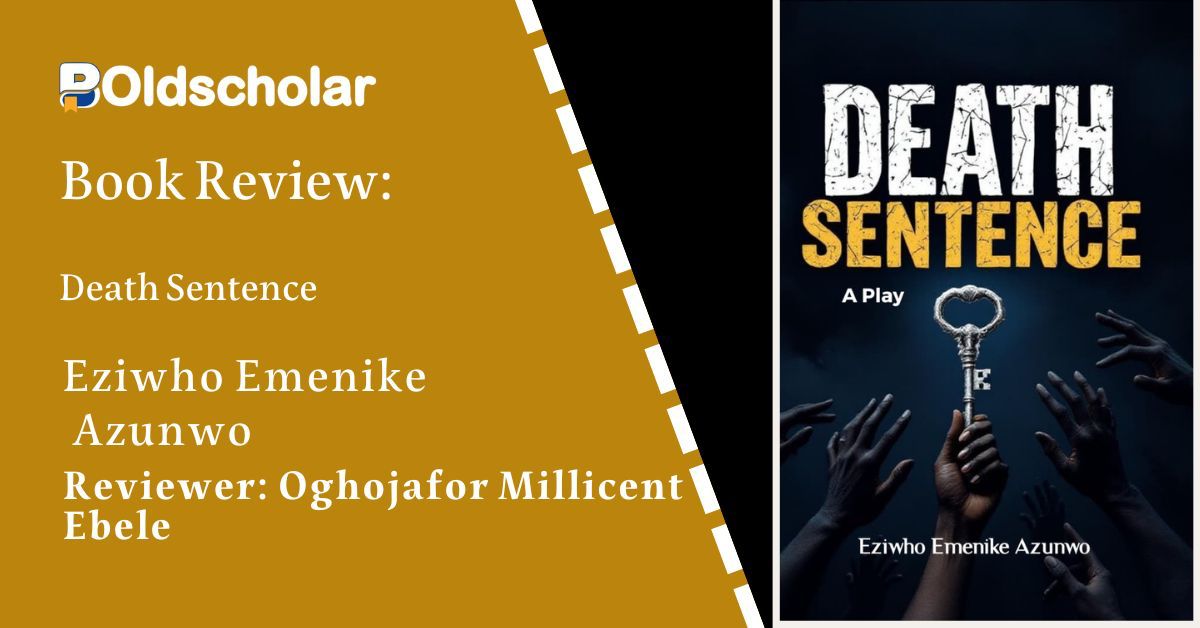
Author: Eziwho Emenike Azunwo
Reviewer: Nneka Chigozie Ikenna-Obi, PhD
Publisher: Covenant Daystar Publishers, Port Harcourt. Nigeria
Pagination: (Number of pages) 111 pages
Year of Publication: 2026
Institution: Rivers State University, Port Harcourt.
Department of Theatre and Film Studies
Introduction
Eziwho Emenike Azunwo’s Death Sentence (2026) is a play set in motion by the death of Dr. Manson, an event that would typically call for unity, mourning, and collective remembrance. Instead, his passing ignites a tense and ethically troubling contest over his estate, exposing the underlying fractures within the family. What should have been a moment of shared grief quickly deteriorates into a battleground defined by suspicion, hostility, and self-interest. Through a deliberately crafted and progressively unfolding plot, the playwright reveals how the lure of material gain can overshadow genuine emotional connections, ultimately turning the family structure into a space marked by rivalry, calculated manipulation, and intense psychological strain.
At the heart of the play is Anita, a central figure whose firm resistance to patriarchal dominance and culturally sanctioned expectations places her in a dual position as both a target of oppression and a symbol of courageous defiance. Her experience is not merely personal but emblematic of a wider societal condition in which women are frequently sidelined in matters concerning inheritance, authority, and decision-making. Through Anita’s struggle, the play foregrounds the persistent inequalities embedded in both traditional and institutional systems. In addition, the narrative critically explores the friction between customary practices and formal legal systems, demonstrating how gaps in estate planning, unclear legal documentation, and the manipulation of cultural norms can be exploited to justify dispossession and deepen familial conflict.
Moving beyond the immediate storyline, Death Sentence operates as a broader commentary on moral deterioration within society. It portrays how moments of loss are often commercialized and distorted, with death itself becoming a strategic opportunity for individuals driven by greed and ambition. The playwright’s use of straightforward yet impactful dialogue, alongside symbolic devices such as the presence of drummers, contributes to a layered dramatic experience that is both emotionally engaging and socially insightful. The steady build-up of tension throughout the play reinforces its thematic concerns, drawing the audience into the gravity of the unfolding events.
In its entirety, the play extends beyond mere storytelling to function as a powerful cautionary narrative. It challenges audiences to critically reassess the ethical foundations of family relationships, recognize the necessity of legal awareness in matters of inheritance, and confront the enduring dilemma of what truly defines a legacy. By juxtaposing love against conflict, and duty against desire, the play ultimately raises profound questions about whether human relationships are governed more by genuine affection or by the relentless pursuit of material gain.
Synopsis
The narrative movement of Death Sentence by Eziwho Emenike Azunwo is firmly rooted in the chaotic and emotionally charged events that follow the death of Dr. Manson, an event that functions as both the trigger of the plot and the emotional fulcrum upon which the entire drama rests. Instead of serving as a solemn moment for shared grief and unity among family members, his demise ignites a bitter and highly contested struggle over the possession and control of his estate. What unfolds is not simply a dispute over material inheritance, but a deeper symbolic conflict that exposes the erosion of trust, the collapse of familial affection, and the weakening of moral responsibility within the family unit. In the absence of the patriarch, a vacuum of authority emerges one that is swiftly manipulated by extended relatives who seek to impose their will by invoking cultural norms, hierarchical privilege, and claims of seniority.
At the core of this intensifying conflict are Dr. Manson’s children, Anita and Chike, who are gradually pushed into positions of isolation and vulnerability as pressure mounts from self-serving family members. These antagonistic forces do not rely solely on brute assertion but carefully employ the language of tradition and customary expectations as tools of dominance, attempting to legitimize their encroachment on the deceased’s property. Consequently, the conflict evolves into a complex intersection where legal rights, moral considerations, and cultural practices collide, leaving the protagonists in a fragile and dangerous position. For Anita especially, the situation demands an extraordinary display of strength, resilience, and ethical resolve, as she must navigate not only the external threats posed by hostile relatives but also the internal emotional burden of mourning within an atmosphere of tension and intimidation.
The synopsis of the play stands out for its clarity, coherence, and ability to sustain audience interest. It presents the central conflict with striking immediacy, drawing attention to the emotional weight and high stakes surrounding the inheritance dispute. At the same time, it effectively cultivates a sense of mounting tension by indicating that the conflict will extend beyond verbal disagreements into more perilous and unpredictable developments. The suggestion of betrayal whether explicit or subtly implied adds further intricacy to the narrative, as shifting loyalties and concealed intentions gradually come to light, enriching the dramatic texture of the story.
Moreover, the synopsis successfully foregrounds Anita as the central consciousness of the play, positioning her as the primary medium through which the audience engages with the unfolding drama. Her centrality operates on both structural and thematic levels, as her experiences encapsulate key issues such as the pursuit of justice, the realities of gender-based marginalization, and the struggle for moral integrity in the face of adversity. The indications of looming danger, combined with the ethical challenges she encounters, introduce layers of suspense and psychological complexity that deepen the narrative’s impact. In this regard, the synopsis transcends its basic function of summarization; it establishes the emotional tone and intellectual depth of the play, preparing the audience for a compelling dramatic experience defined by intense conflict, shifting power dynamics, and profound moral interrogation
Themes
Greed and Materialism
The play strongly emphasizes how wealth can distort familial relationships. From the moment of Dr. Manson’s death, relatives who should show support instead “converge on his estate with calculated intentions” (Synopsis, p. 9). Greed drives uncles and aunties to manipulate, intimidate, and threaten Anita and Chike in order to seize control of the inheritance (Scene Two, p. 24–34). This theme highlights the corrupting influence of materialism on human behavior and the danger of prioritizing wealth over kinship.
Betrayal and Familial Conflict
Betrayal is central to the drama, particularly the idea that those closest to us can become our enemies. Anita experiences shock and disillusionment when family members she trusted attempt to overtake her father’s properties (Scene Two, p. 27). The play portrays betrayal not as sudden, but as latent, emerging under pressure when self-interest is pitted against loyalty. This tension explores the fragility of trust within families.
Gender and Patriarchy
Anita’s struggle as a female heir underscores the theme of gender inequality. Her uncles attempt to override her rights based on traditional customs, asserting male authority over property (Scene Two, p. 27). Anita’s resistance challenges patriarchal norms and highlights the societal expectation that women, even as firstborns, may be denied inheritance. The play critiques these entrenched gender biases, presenting a protagonist who asserts agency in defiance of convention.
Justice, Law, and Moral Responsibility
The legal system and morality play a key role in the narrative. Characters like Barrister Ume and Barrister Oke represent both the protective and procedural aspects of law (Scene One, p. 14–21; Scene Two, p. 36–40). The tension between legal rights and moral obligations drives the plot. The play asks whether justice can prevail over greed and questions the ethical responsibilities of those managing another’s legacy.
Resilience and Courage
Anita embodies resilience, standing firm against intimidation and threats from her relatives (Scene Two, p. 32–34). The theme highlights personal courage in the face of adversity, showing that integrity and perseverance can counteract exploitation. Her moral and emotional strength contrasts sharply with the opportunism of her uncles and aunties, providing a model of virtuous resistance.
Family, Loyalty, and the Meaning of Legacy
The play interrogates what remains after death: is it wealth or the memory of love and ethical action? Dr. Manson’s death triggers reflection on the true meaning of legacy (Preface, p. 4–5). The conflict reveals that blood ties do not guarantee loyalty, and that family can be both a source of support and oppression. The theme explores how values, not just assets, constitute a meaningful inheritance.
Death Sentence uses the inheritance conflict as a lens to examine societal issues such as greed, betrayal, gender inequality, justice, resilience, and the deeper meaning of family and legacy. These themes intertwine to make the play both a personal and social critique.
Characterization
Anita Manson: The moral and emotional anchor. She embodies resistance, justice, and resilience. Her evolution from composed daughter to embattled defender is convincing and central to the play’s impact.
Chike Manson: A passive but symbolic figure representing vulnerability and the masculine retreat from conflict.
Uncle Joe: The primary antagonist, representing patriarchal dominance and greed. His character is forceful but somewhat predictable.
Aunty Ruth: A complex manipulator whose duality (nurturing façade vs. hidden agenda) adds depth to the narrative.
Barrister Oke: Represents compromised professionalism and ethical ambiguity within legal systems.
DPO Sam: Symbolizes institutional intervention, though his role remains limited.
While the characters effectively drive the thematic concerns, some lack psychological complexity, functioning more as archetypes than fully developed individuals.
Language and Style
The language employed by Azunwo is accessible, direct, and performative, suited for stage delivery. Dialogue dominates the narrative, with minimal reliance on elaborate stage directions beyond symbolic elements like drummers. Drumming and musical undertones are employed to accentuate key scenes, linking the play to African performance traditions while intensifying emotional tension. The stage directions are meticulously detailed, guiding performances to reflect both the realism and symbolic richness of the text.
The play makes effective use of colloquial expressions to enhance realism and ground the dialogue in familiar social contexts, thereby making the characters more relatable. It also employs repetition and strategic emphasis as rhetorical devices to intensify emotional tension and reinforce key moments within the narrative. The symbolic incorporation of drummers further enriches the dramatic texture, underscoring mood shifts and marking transitions between scenes with cultural and emotional resonance. However, despite these strengths, the dialogue occasionally lapses into a didactic and overly explicit mode, which can limit interpretive subtlety and diminish the complexity of thematic expression.
Dramatic Techniques
Symbolism: Drummers serve as emotional and cultural markers.
Music/Drumming: Serves as emotional punctuation, connecting to traditional African dramaturgy.
Conflict-driven dialogue: Sustains tension throughout the play.
Monologic reflections: Anita’s direct address to the audience enhances engagement and thematic clarity.
Suspense elements: The break-in scene introduces thriller-like intensity.
Socio-Political Commentary
Death Sentence operates as a compelling reflection of the intricate realities of contemporary Nigerian society, particularly in its exploration of power dynamics, corruption, justice, and social inequities. Central to the play is the contentious inheritance dispute and the moral deterioration that envelops it, which functions as a microcosm of broader systemic failures in governance and societal values. Through the manipulations of antagonistic forces and the ethical quandaries confronting the protagonists, the play incisively critiques a pervasive culture of greed and the gradual erosion of moral principles, both within familial structures and the public sphere.
The narrative foregrounds the often-fraught tension between law and morality. Characters repeatedly encounter circumstances in which legal structures are inadequate or manipulated, revealing how societal institutions can be exploited by those wielding influence and privilege. In doing so, the playwright emphasizes the consequences of unbridled ambition and ethical compromise, portraying a society where personal advancement frequently takes precedence over communal responsibility. This socio-political examination is further enhanced through a nuanced depiction of social hierarchies, gender relations, and the contestation of wealth and inheritance, illustrating how power is asserted, negotiated, and maintained across both public and private arenas.
Moreover, Death Sentence probes the notion of accountability with remarkable subtlety. The tragic paths of certain characters underscore the perils of moral lapses, while the narrative’s resolutions highlight the persistent tension between individual responsibility and systemic shortcomings. Implicitly, the play urges the audience to reflect on their own ethical and civic obligations within a society where injustice has become normalized. In this regard, the work offers a timely and incisive commentary on the interplay between personal morality and larger socio-political realities, inviting viewers to consider not only the consequences of individual actions but also the structural forces that shape ethical conduct and societal outcomes.
Comparative Perspective
From a comparative perspective, Death Sentence resonates strongly with other seminal African dramatic works that probe themes of power, corruption, and social justice, such as Femi Osofisan’s Morountodun and Wole Soyinka’s Death and the King’s Horseman. In a manner akin to these plays, Azunwo weaves traditional African performance conventions drumming, chorus-like commentary, and evocative musical undertones into a contemporary narrative framework, creating a dual emphasis on cultural authenticity and incisive socio-political critique. This synthesis allows the play to engage audiences both aesthetically and intellectually, bridging the richness of indigenous performance traditions with the pressing moral and social concerns of modern life.
The play’s exploration of moral ambiguity, human frailty, and societal decay also invites comparison with classical European tragedies, where protagonists’ flaws intersect with external pressures to precipitate inevitable consequences. Yet, what sets Death Sentence apart is its firm grounding in African communal ethics and cultural norms. This localized lens offers a unique approach to universal questions of justice, morality, and authority, ensuring that the narrative’s ethical dilemmas are understood not only as personal struggles but as communal concerns. The deployment of African performative elements serves more than an ornamental function; it amplifies the social and collective dimensions of individual actions, embedding personal choices within a broader cultural and societal context.
In juxtaposition with contemporary Nigerian literature and cinema addressing corruption, injustice, or social inequality, Death Sentence distinguishes itself through the immediacy of its theatrical form. Rather than simply recounting events or moral lessons, the play enacts the psychological and ethical tensions in real time, allowing audiences to viscerally experience the stakes of its narrative. This dynamic interplay between tradition and modernity, local specificity and universal relevance, positions Azunwo’s work as both a critical commentary on Nigerian socio-political realities and a compelling exploration of human ethics that resonates with audiences beyond national boundaries.
Ultimately, Death Sentence functions as both a socio-political critique of contemporary Nigerian society and a sophisticated comparative study in ethical drama. By fusing African cultural expression with universal questions of power, justice, and morality, the play invites reflection on the reciprocal relationship between individuals and the societies they inhabit, affirming its status as a work of profound local significance and global relevance.
Critical Evaluation
Strengths:
The play demonstrates several notable strengths, foremost among them its strong thematic relevance and incisive social critique, which engage audiences with pressing societal issues. Central to its impact is the compelling characterization of Anita, whose struggles and moral dilemmas anchor the narrative and elicit empathy. The playwright skillfully maintains dramatic tension throughout, employing pacing that heightens suspense and sustains audience engagement. Additionally, the work presents clear moral positioning, inviting viewers to reflect on ethical questions and fostering active audience involvement in the unfolding drama.
Weaknesses:
The play, however, is not without its shortcomings. At certain moments, it lapses into melodramatic excess, which can somewhat diminish the subtlety of its emotional impact. The antagonists, while functional to the progression of the plot, occasionally lack sufficient depth and complexity, making their motivations appear less nuanced than those of the central characters. Additionally, the dialogue at times tends to over-explain thematic concerns, leaving little room for audience interpretation or dramatic inference. The resolution, though thematically consistent, does not fully achieve a sense of dramatic closure, thereby creating a lingering impression of incompleteness in the play’s overall structural arc.
Conclusion
Death Sentence is a powerful socio-dramatic work that interrogates the intersection of family, law, and morality in contemporary African society. Despite minor structural and stylistic limitations, the play succeeds as both a theatrical piece and a social commentary, urging audiences to reconsider the consequences of greed, the importance of legal clarity, and the fragility of familial bonds.
Share this post



Be the first to comment on this post