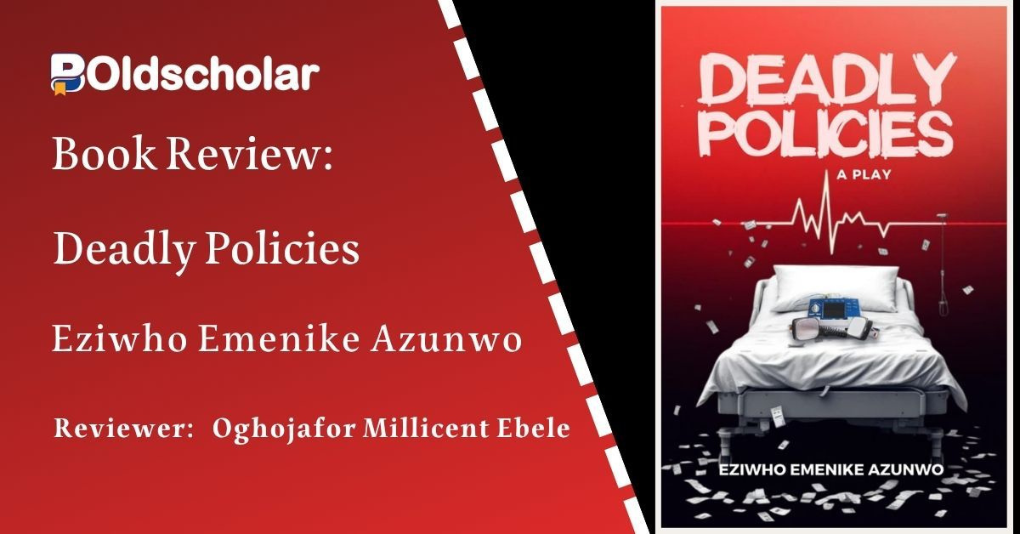
Title: Deadly Policies
Author: Eziwho Emenike Azunwo
Reviewer: Oghojafor Millicent Ebele
Publisher: Covenant Daystar Publishers
Pagination: 56 pages
Year of publication: 2026
Institution: Rivers State University, Port Harcourt, Department of Theatre and Film Studies.
Introduction
The play Deadly policies goes beyond art for art sake. It is more than a text, it is a tragic satire. Emenike Azunwo discusses a subject that is both educational, sensitive and cuts deep in our society today. In Nigeria about 25,000 persons die annually due to negligence. This is a critical highlight in the Nigerian healthcare sector, 40% of that number die due to lack of access to care. Many cases around negligence go unreported because of the fear of prolonged legal cases, poverty or even bribery. A 2017 study found a 42.8% negligence rate among surveyed medical practitioners. This play is a call for action in the Nigerian health sector. The play also shines a light on emotional intelligence, compassion, empathy, kindness, faith and family dynamic . This review will analyze the play’s thematic complexity, character construction, linguistic style, and socio-political relevance, arguing that Deadly Policies serves as a powerful narrative for social change in the health sector.
Synopsis
This play interrogates the concept of hospital negligence, defined as the failure of medical institutions or personnel to meet the expected standard of care, often resulting in harm through delay, inaction, or improper treatment. It centres on Engr. Tony, a morally upright man whose life takes a tragic turn when he becomes a victim of an inefficient and profit-driven healthcare system. Rather than serving as a site of healing, the hospital is depicted as a space marked by bureaucracy, emotional detachment, and ethical compromise. The narrative exposes the contradiction between medical practice and the ethical commitments of the Hippocratic Oath, particularly the principle of non-maleficence. Despite his family’s efforts, including a substantial deposit toward his treatment, Engr. Tony is denied timely care, ultimately leading to his death. The play thus offers a poignant critique of Nigeria’s healthcare system, foregrounding the devastating consequences of prioritizing profit over patient welfare.
Thematic explorations
The commercialization of healthcare
The Nigerian healthcare system has long been marked by structural underfunding, institutional corruption, and deeply problematic medical payment policies. Among the most controversial of these, is the requirement that patients pay for treatment in full before care is initiated, a policy that persists even during life-threatening emergencies. Numerous investigative reports and research studies document cases, where critically ill or injured people are denied medical attention due to inability to pay upfront, resulting in preventable deaths. Against this backdrop, the play dramatizes the harsh realities of such policies through a gripping narrative set in a private hospital in Nigeria. Through its characters, conflicts, and dialogue, the play interrogates the tension between institutional policy and medical ethics, exposing the moral bankruptcy of a system in which human life is subordinated to financial bureaucracy. A sad reality where every life does have a price tag determined by the healthcare provider attached to it.
Medical Ethics vs. Hospital Policy
A major moral conflict is embodied in the character of the attending doctor, who is torn between the Hippocratic oath and administrative constraints. The character of Nurse 2, is also a bit sympathetic to the Toyin family, and offers the only help she can, which is to take Ayanfe to Dr. Joe. Through emotional dialogue and internal conflict, the playwright explores the ethical dilemma faced by Nigerian healthcare workers trapped in an underfunded system. The fear and experience of having runaway patients or patients who default in payment, using pitiful stories after proper treatment, is a gamble the hospital staff is unwilling to take. That also contributed to the unbending of the hospital's policy.
Revenge birthed by emotional trauma
The play begins with a tragedy and ends as one. The continuous suffering of the patient and the helplessness of the family evoke themes of dignity, compassion, from the audience and emotional resilience. The family goes through intense emotions of panic in the beginning, which quickly changes to pain from loss, and then anger that leads to a drastic action by Ayanfe and catharsis.
Healthcare inequality and social injustice
One of the central themes is the inequitable distribution of healthcare resources. The play vividly illustrates how poor Nigerians are disproportionately harmed by the monetization of emergency services. The contrast between affluent patients who can bypass processes with ease and impoverished ones exemplifies structural injustice. It is no news that most Nigerians go to private hospitals, which are actually more expensive, for better and swifter healthcare services, because the public ones most times lack basic amenities and offer poor services.
Bureaucracy and Institutional Failure
The hospital administrator represents the rigidity and impersonal nature of Nigerian public institutions. His insistence on “policy” as an absolute rule reveals how
bureaucracy becomes a mechanism of violence. The urgency of the situation unfortunately clashes with the cruelty of bureaucracy. This play possesses a very important question, which is. How do we move forward as a society when the systems and laws created for the growth and protection of citizens and institutions become the same thing that leads to their end?
Characterization
Azunwo's characters in this play are not merely fictional, they are symbolic representations of persons in society, who have had to bear the burn of unreasonable and irrational rules.
Ayanfe
He was initially described as unknown at the beginning of the play. He is the only son and eldest child of Mr and Mrs Toyin. Before the tragic incident of his father we can slightly deduce that he is responsible and level headed. It is obvious that he loves his family and is willing to go any length for them. After taking his father to the hospital, he begs the hospital staff severally to attend to his father despite being turned down severally. He goes out to raise the balance of #300,000, but unfortunately comes back to meet a tragedy. His worst fears happened. After his loss he makes a resolve to seek vengeance and to pay back in the same coin he was served, which is to show no mercy. Ayanfe's drastic resolve could be said to be birthed from a place of grief and rage, most especially due to the fact that it could have been avoided if not for the unjust policy of the hospital . Ayanfe's character could probably be seen as justified in the end of the play.
Mrs. Toyin
She is the wife of Mr. Toyin. A mother to two children, Ayanfe and Ajoke. A woman who has been given an unjust fate by life. From being a primary care giver to her loving husband, she swiftly becomes a widow due to a wicked policy.
Mr. Toyin
An upright man in society, one who has lived his life by the books. A loving father and husband, who has obviously seen better days, before his unfortunate encounter with sickness. He is immensely loved by his family. The plot revolves around him. As a man of the community he was a voice but unfortunately, he couldn't speak to save himself, when it mattered the most. His tragedy leads to the catharsis.
Ajoke
She is the only daughter and youngest child of Mr and Mrs Toyin. She shares a cordial father daughter relationship with her father. We are able to deduce the love and affection between them. But unlike the relationship she has with her father, her relationship with her mother is slightly opposite. Her mother doesn't hide her displeasure with her presence, which she doesn't appreciate because she is expected to be in the family house not occupied with work but tending to her ill father, as a proper African daughter. Ajoke could hardly keep it together when her father is rushed to the hospital, she cries uncontrollably and pleads on behalf of her father to get treated.
Doctor Joe
The attending physician, whose cold adherence to hospital policy overshadows his duty to save lives. He goes against his medical oath on the altar of profit. As a practicing Doctor of six years and a Christian, he is expected to know better. His only alternative was that Mr. Toyin be transferred to another hospital with a different policy, this was an insensitive and unrealistic option, considering the fact that Mr. Toyin was already in a very critical condition and attempting to move him could lead to a fatal result. Although he seemed to have been moved by the tragedy, like anyone who is not a direct recipient of a tragedy, he quickly moves on, forgetting the scar left on the bereaved.
Nurse 1, Nurse 2, Nurse 3
These characters help to drive the story line further. Their roles aren't just critical to the setting of the play (which is the hospital), but also to the plot. They portray varying emotions to the hospital's policy. While nurses one and three, hold strongly to the hospital'spolicy, are very detached, and unable to show empathy, pity or even any remorse. Nurse two, who is much younger, is a bit empathetic and helps the Toyin family by taking Ayanfe to the Doctor. Nurses one and three, are unapologetic even after the tragedy of the Toyin family. They even try to justify their actions and get into altercations with the other patients present at the lobby on several occasions.
Patient One, Two, and Three
They join their voices with that of the Toyin's, pleading with the hospital staff. They also criticize them for their refusal to help the Toyin's. They get into physical altercations with the nurses. They refuse to ignore the harsh attitude given to the Toyin's. Their agitation for fair treatment restores hope in humanity. Their empathy is natural and should have been emulated by both the Doctor and nurses.
Drummers
They set the mood of the play. They help intensify and give life to conversations in each scene, and add dramatic effect. They also help with a smooth transitioning between scenes. They also give special effects in the play.
Language
The dialogue is realistic, emotionally charged, and socially reflective. The playwright makes use of everyday and easy to understand words. The dialogue helps in the relativity of the play.
Dramatic technique
Foreshadowing
It generated tension, heightened anticipation, and prepared the reader for significant, and negative, events.
"Patient 2: You think life ends here in this hospital, one day it will be you on that floor"
P. 46
Setting
The use of hospital setting is not just a physical location but a metaphor for Nigeria itself.
Symbolism
Common objects such as hospital forms, receipts, and waiting benches symbolize systemic barriers.
Societal relevance
The play engages with ongoing national debates about emergency healthcare
reform. Despite the passage of policies intended to guarantee emergency care irrespective of payment, implementation has been inconsistent. This book should be recommended to every Nigerian, in order to draw more awareness to this issue.
Conclusion
The reviewed play is a compelling and socially relevant dramatic work that draws attention to one of Nigeria’s most troubling healthcare policies. Through strong characterization, emotional storytelling, and incisive social critique, the playwright exposes the moral and institutional failures that place countless Nigerians at risk. The play succeeds artistically and ethically, functioning as a powerful call to action for healthcare reform.
References
Azunwo,E. (2025) Deadly Policies.
Covenant Daystar Publishers.
World Health Organization. (2019). Emergency care systems framework. World Health
Organization. (2021). Universal health coverage: Nigeria country profile. National Health Act. (2014).
Federal Government of Nigeria. Okafor, S. (2020). Healthcare inequality in Nigeria: An overview.
Journal of African Social Policy, 12(3), 44–58. Adeyemi, T. (2019). Bureaucratic challenges in Nigerian
public hospitals. African Governance Review, 7(2), 89–103.
Share this post




Be the first to comment on this post