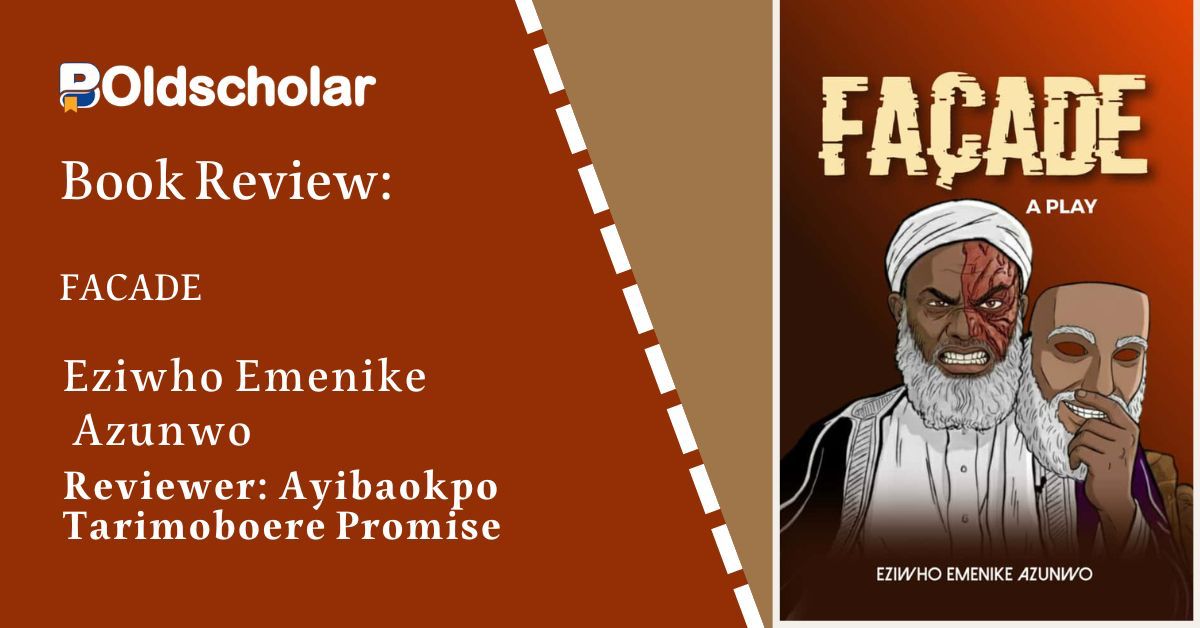
Book Title: Facade
Author: Dr. Eziwho Emenike Azunwo
Reviewer: Ayibaokpo Tarimoboere Promise
Publisher: Covenant Daystar Publishers
Pagination (number of pages): 102 pages
Year of Publication: 2026
Institution: Rivers State University, Port Harcourt,
Department of Theatre and Film Studies.
INTRODUCTION
Facade opens the eyes of its readers to see the pettiness and cruelness of politicians where political parties stoop low in pursuit for power. Murder, revenge, looting, bribery with loss of lives and arrest as the end results for the politicians wickedness towards citizens and opposing forces. The characters' motivations and actions are layered and multi-dimensional, reflecting the complexity of human nature. It's multiple plot twists and turns, keeps the audience engaged and guessing. The use of symbolism, such as the title "Facade", adds depth and complexity to the narrative. The play's themes of power, ambition, and deception are intricately woven throughout the story, reflecting the messy and often contradictory nature of politics and human relationships.
SYNOPSIS
Dr. Ajawobu's journey into politics is driven by a desire to create positive change in Nigeria and redefine the narrative around politicians. His vision is to prioritise the people and create a better environment for all.
However, his decision to merge with a corrupt party, allegedly involved in his father's death raises questions about his judgement and the compromises he's willing to make. His family's warning highlight the potential risks to his values and goals. On the other hand is Alhaji Danjuma, a cunning and influential figure drawn into a perilous game of politics and deception. As he navigates the shadowy corridors of power, alliances fracture, trust crumbles and ruthless cost of greed consumes him. Facade is a gripping tale of ambition and how power can poison even the strongest, it reveals the devastating journey of those who crave control.
THEMES
The Corrupting Influence of Power: The play explores how the pursuit of power and influence can lead individuals to sacrifice their values, morals, and relationships, ultimately consuming them.
Ambition and Greed: The narrative highlights the dangers of unchecked ambition and greed, which can drive individuals to prioritize their own interests over everything else, including their humanity.
Deception and Betrayal: The play showcases how deception and betrayal are inherent in the game of power, where loyalty is a luxury and trust is a weakness to be exploited.
The Illusion of Control: The story reveals that even the most powerful individuals are vulnerable to the consequences of their actions, and that fate can be a powerful force in shaping their downfall.
The Destructive Nature of Unchecked Desire: The play illustrates how unbridled desire for power and influence can lead to chaos, destruction, and ultimately, self-destruction.
The Elusive Nature of Truth: The narrative highlights how truth is often obscured by deceit and manipulation, making it difficult to discern reality.
The Inevitability of Downfall: The play suggests that those who pursue power and influence at any cost will ultimately face a reckoning, as the web of fate tightens around them.
CHARACTERIZATION
Senator Harry: Like a still pond; calm on the surface, but currents of ambition swirl beneath. His cunning nature and self-interest make him a master of manipulation, using words to mask true intentions.
Senator Mark: His character is present but unnoticed, influential yet invisible. His silence isn't weakness, but a calculated move to preserve his position.
Bassey: A young, vibrant and intelligent man, dislikes corrupt politicians. He risks his life to expose Alhaji Danjuma and others.
Alhaji Danjuma: This character is like a spider in a self-spun web, he has built a network of influence, but now he is entangled in his own ambitions.
Party Chairman (Otunba Olajide): Otunba Olajide is like a puppeteer with unraveling strings, confident in his control until the puppets start pulling their own strings.
Dr. Ajawobu: Dr. Ajawobu is like a lighthouse in a storm, steadfast and guiding, but challenging the turbulent seas around him. Integrity drives him, even if it means standing alone, his vision exposes the flaws in the system.
Nikita: Graceful, elusive, and always a step ahead. Her wit and charm are her tools, and the political underworld is her playground.
Ashley: Dr. Ajawobu's secretary
Professor Pat: Wisdom guides her restraint, she watches, knowing actions have consequences and quiet words carry weight.
Mc Mouthful: Mc Mouthful 's character is like that of a masked jester, laughing on the outside, cutting deep with truth. His sharp tongue exposes hypocrisy, making others uncomfortable.
Uncle Gabriel: Politics is a game, and he'll do whatever it takes to win. He is like a grandmaster, calculating, ruthless, and always thinking several moves ahead.
Comrade Osazuwa: Always pointing where the wind blows. He will align with whoever's in power to stay in the game.
Chief Okaka: Trapped by his own wealth. He funds schemes not out of ambition, but fear of being exposed or left behind.
Officer 1: Straightforward, unyielding, and aimed at breaking the chains of corruption.
Young Man: Innocence meets harsh reality, politics finds him before he's ready. He is drawn in by the unknown, despite the risks.
1st Man: Loyal, echoing every move of the powerful.
2nd Man: He reflects the 1st Man, moves when he moves.
Other Characters: Journalists, security, attendants, and aides; witnesses to power's front stage and backstage. They make the scene come alive. Each has a story, a role, and a choice.
LANGUAGE AND STYLE
The language used in the play is a vibrant and dynamic blend of Standard English, Nigerian Pidgin English, Hausa, and Igbo, creating a rich linguistic tapestry that reflects the cultural diversity and multilingual nature of Nigerian society.
Eziwho's masterful code-switching between these languages adds depth, nuance, and authenticity to the dialogue, allowing the audience to connect with the characters and their experiences on a deeper level. The use of Nigerian Pidgin English, in particular, brings a sense of informality and familiarity to the conversations, making the characters feel more relatable and real.
The incorporation of Hausa and Igbo phrases and expressions adds a layer of cultural specificity, grounding the play in its Nigerian context and highlighting the complexities of identity and belonging in a multilingual society. This linguistic diversity also serves to underscore the themes of power, class, and social status, as the characters navigate different linguistic and cultural registers to negotiate their relationships and interests. Overall, the language of the play is a powerful tool for storytelling, character development, and social commentary, showcasing Eziwho's skill as a playwright and deep understanding of the Nigerian linguistic landscape.
DRAMATIC TECHNIQUES
Facade employs several dramatic techniques:
Character-driven plot: Complex characters like Dr. Ajawobu and Alhaji Danjuma drive the story, showcasing the corrupting influence of power.
Conflict and tension: Power struggles, loyalty vs. betrayal, and moral decay create tension and keep the audience engaged.
Symbolism: The "facade" itself might symbolize the characters' hidden true selves or the societal masks they wear.
Irony and plot twists: The play's twists likely add to the gripping narrative, highlighting the themes of deception and corruption.
SOCIO - POLITICAL COMMENTARY
Azunwo's "Facade" is a political play that tackles pressing issues in Nigeria's political sector, including mismanagement of funds, abuse of power, greed, murder, and diverting of public funds. The story exposes the ills plaguing Nigeria's political system, prompting audiences to confront the failures of governance. Through its characters, the play raises critical questions about the system, projecting a stark contrast between the public image and private actions of political leaders and parties. By wearing a "Facade" of innocence, these leaders hide their evil deeds, and the play forces audiences to confront this harsh reality.
CRITICAL EVALUATION STRENGTHS
The strengths of Azunwo's "Facade" include:
Cultural authenticity: The use of Hausa and Nigerian Pidgin English show Nigeria's linguistic diversity, grounding the story in a real and relatable environment.
Universal themes: The play tackles worldwide issues like corruption, greed, and deception, making it easy for audiences all over the world to connect.
Emotional impact: The tragic events and character struggles evoke a powerful emotional response.
Thought-provoking title: "Facade" perfectly captures the play's essence, inviting reflection on the themes.
Accessible storytelling: English language and interpreted Hausa dialogues make the story accessible to a broad audience.
These strengths combine to make "Facade" a gripping and impactful play
WEAKNESSES
One potential weakness of the play is the limited use of indigenous languages. Aside Alhaji Danjuma, characters like the Yoruba and Igbo characters spoke only English and a bit of Pidgin, which might not accurately reflect real-life communication patterns in Nigeria. In a Nigerian setting, characters often code-switch between English and their native languages, adding flavor and authenticity to the dialogue. Incorporating more Yoruba, Igbo, and other languages could have enhanced the story's realism and cultural representation, given the Nigerian environment.
This observation highlights the importance of linguistic authenticity in storytelling, especially when depicting diverse cultures
CONCLUSION
In conclusion, "Facade" is a gripping tale of how power and ambition can corrupt even the strongest individuals, leading to moral decay and destruction. Dr. Ajawobu and Alhaji Danjuma's downfalls serve as cautionary tales of the dangers of unchecked ambition and the blurred lines between loyalty and betrayal. The play's complex characters and plot twists keep you guessing, while its themes of power, deception, and human nature leave you reflecting on the true cost of ambition. The play "Facade" is a thought-provoking commentary on the darker aspects of human nature and the corrupting influence of power in Nigerian politics.
REFERENCES
Azunwo, E. E. (2025). Facade: A play. Port Harcourt: Covenant Daystar Publishers.
Binebai, B (2022). Heroes of our Errors: A play. Enugu: CNC Publications, Limited.
Share this post



Be the first to comment on this post