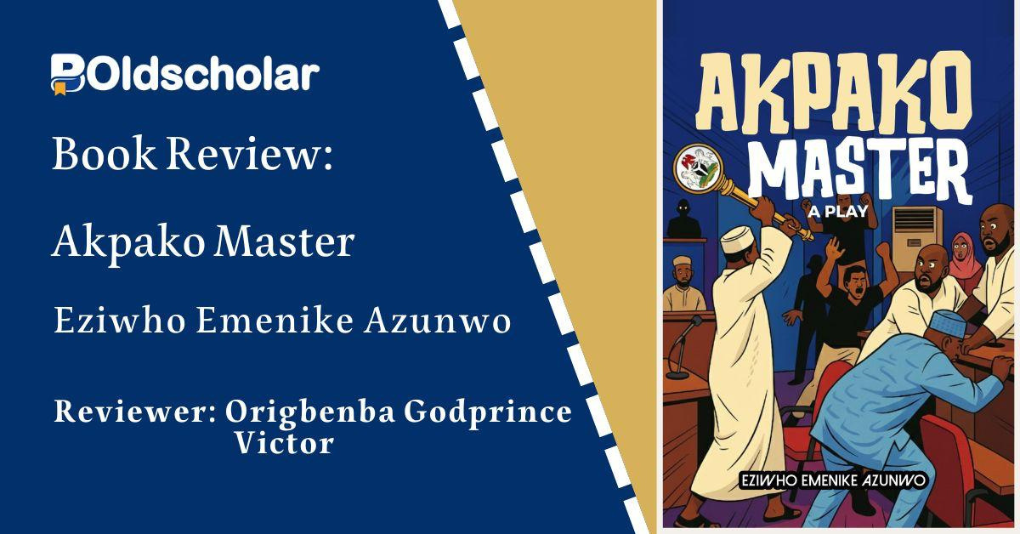
Book Title: Akpako Master
Author: Dr. Eziwho Emenike Azunwo
Reviewer: Origbenba Godprince Victor
Publisher:Convenant Daystar Publishers
pagination: 69 pages
Year of publication: 2026
Institution: Rivers State University, Port Harcourt
Department: Theatre and Film Studies
Introduction
Eziwho Emenike Azunwo's Akpako Master (2025) is a boldly conceived political drama that interrogates the dynamics of power, loyalty, and corruption within a community assembly. Azunwo, an accomplished playwright and scholar with a significant body of socially conscious drama, here directs his creative attention to the systemic decay within democratic governance structures in contemporary Nigeria. The play's title, Akpako Master, carries strong cultural and satirical resonance, evoking the image of a street-smart political manipulator who thrives in environments where cunning supersedes principle. Rather than presenting a simple conflict between good and evil, the play reveals a more unsettling reality: that corruption and institutional failure are products of collective complicity, where leaders and followers alike are ensnared in a cycle of patronage, ambition, and moral compromise.
The text situates itself firmly within the tradition of Nigerian political drama, drawing from naturalistic settings, strategically layered dialogue, and symbolic dramatic structures to expose the tragic consequences of governance without ethical responsibility. As with many of Azunwo's works, Akpako Master is less concerned with entertainment in the conventional sense and more with the social and ethical obligations of theatre as an instrument of reform and critique. This review provides a critical examination of the play, considering its themes, narrative structure, characters, language and style, dramatic techniques, and social relevance, while situating it within the broader Nigerian and African dramatic tradition.
Synopsis of Akpako Master
Eziwho Emenike Azunwo’s Akpako Master is a political drama that interrogates the dynamics of power, loyalty, and corruption within a community assembly. The play presents a society where political ambition overrides ethical considerations, and where both leaders and followers are complicit in the erosion of institutional integrity. The narrative begins in the residence of Barrister Okolie, a calculated political strategist who expresses dissatisfaction with the leadership of the Ruler. In a private meeting with Honourable Uche and Honourable Bari, he outlines a plan to mobilise members of the community assembly against the Ruler. The objective is to engineer his impeachment by securing the support of the majority through financial inducements and strategic persuasion. This initial scene establishes the foundation of the conspiracy and reveals the extent to which political influence is treated as a negotiable commodity.
The plot gains momentum when Honourable Uche, acting as Minority Leader, approaches Honourable Mark, the Speaker of the Assembly, in an attempt to win him over. Uche’s approach is both strategic and provocative, combining subtle flattery with open promises of political advancement and financial reward. However, Mark refuses to be swayed, rejecting the proposal despite the attractive incentives attached to it. His response introduces a counterforce within the narrative, as he represents a form of loyalty that resists immediate compromise. Following this encounter, the Speaker visits the Ruler to disclose the existence of the impeachment plot. In a surprising turn, the Ruler reveals that he is already aware of the conspiracy, suggesting a deeper level of political awareness and control. Rather than reacting defensively, he affirms his trust in the Speaker and provides resources to ensure that the majority members remain aligned with him. This moment highlights the parallel strategies employed by both factions, as each relies on inducement and influence to maintain support.
Meanwhile, Barrister Okolie reassesses the situation in consultation with Chief Ekene, a powerful and pragmatic political actor. The failure to secure the Speaker’s allegiance is recognised as a significant challenge, prompting renewed efforts to strengthen the opposition’s position. Their discussion reflects a shared determination to remove the Ruler, even if it requires more aggressive tactics. On the other side, the Speaker convenes a meeting with the majority members to inform them of the impending impeachment attempt. Although the members express support for the Ruler, their interactions reveal underlying suspicion and distrust, as each individual questions the loyalty of others. The distribution of financial incentives further reinforces the idea that allegiance within the assembly is largely transactional rather than principled.
The climax of the play occurs during a formal sitting of the community assembly. What begins as a routine legislative session quickly degenerates into disorder when Honourable Uche openly challenges the Speaker’s authority. His refusal to comply with procedural control leads to his suspension, an action that immediately escalates tensions within the chamber. The situation rapidly descends into chaos, with verbal confrontations giving way to physical violence. In the ensuing struggle, the symbolic mace, which represents legislative authority, is seized and used as a weapon, marking the complete breakdown of order and decorum. By the end of the play, the impeachment effort collapses amidst confusion and violence, leaving behind a fractured institution and damaged relationships. Akpako Master ultimately portrays a political system in which the pursuit of power is detached from moral responsibility. The play suggests that the failure of governance is not solely the result of corrupt leadership, but also the consequence of collective complicity, where ambition, fear, and personal gain undermine the possibility of genuine accountability.
Themes
The concept of theme occupies a central position in literary analysis, as it encapsulates the fundamental ideas a text seeks to communicate. As Morris Weitz argues, a literary theme represents the underlying meaning of a work, often conveyed through the interplay of characterisation, plot development, setting, and dialogue (Weitz, 2002).
Political Corruption and Patronage: The dominant theme in Akpako Master is the prevalence of corruption within political institutions. The play exposes a system in which loyalty is routinely commodified and political support is secured through inducements rather than ideological commitment. Both the ruling faction and the opposition engage in similar transactional practices, suggesting that corruption is not confined to a single group but is structurally embedded within the political environment. This normalisation of patronage undermines the integrity of governance and reduces public office to a site of personal enrichment and negotiation.
Power Struggle and Political Opportunism: The narrative foregrounds the relentless contest for political control among competing actors. The impeachment plot is not driven by ideological disagreement but by strategic calculation and ambition. Characters such as Uche, Okolie, and Ekene embody varying degrees of opportunism, where alliances are formed and broken in pursuit of advantage. The theme highlights how political engagement is often shaped by self-interest rather than collective responsibility, resulting in instability and continuous conflict.
Failure of Leadership and Institutional Breakdown: The play presents a clear depiction of leadership failure across multiple levels of authority. The Speaker’s inability to maintain order, the Ruler’s reliance on inducement, and the opposition’s descent into disorder collectively illustrate a weakening of institutional structures. The community assembly, which should represent democratic governance, becomes a site of chaos and violence. This reflects the fragility of institutions when leadership is not anchored in accountability and ethical responsibility.
Betrayal and Political Mistrust: A pervasive sense of suspicion runs through the interactions of the characters. Political alliances are unstable, and loyalty is constantly subject to doubt. Even within seemingly unified groups, individuals question one another’s intentions. This atmosphere of mistrust intensifies the conflict and contributes significantly to the collapse of coordinated political action. The theme underscores the difficulty of sustaining governance in an environment where trust is absent.
Violence and the Collapse of Civil Order: The climax of the play introduces violence as the ultimate expression of unresolved political tension. The transformation of the assembly chamber from a deliberative space into a battlefield illustrates the breakdown of institutional restraint. The seizure of the mace, a symbol of legislative authority, signifies the erosion of democratic order and the substitution of force for dialogue. This theme reinforces the consequences of unchecked political rivalry.
Moral Decline and Ethical Erosion: Underlying the events of the play is a broader concern with the erosion of ethical standards in public life. Characters operate with minimal regard for moral principles, prioritising expediency over integrity. This moral decline is reflected in the ease with which corruption, manipulation, and coercion are employed as routine political tools. The play thus presents a society in which ethical considerations have been subordinated to political survival and personal gain.
Characterization
Honourable Uche: A symbol of restless ambition and political desperation, Uche embodies the aggressive pursuit of power within the opposition. As Minority Leader, he is bold, persuasive, and calculating, evident in his attempt to recruit the Speaker through promises of wealth and advancement. However, his impatience and lack of restraint ultimately define him. His conduct during the assembly sitting, marked by defiance and eventual violence, reveals a character unable to balance ambition with discipline. He represents the dangers of unregulated political hunger, where the desire for power overrides institutional order.
Honourable Mark: The Speaker is portrayed as a figure of controlled authority and calculated loyalty. At first glance, he appears principled, resisting attempts to compromise his position despite enticing offers. However, his interaction with the Ruler reveals that his loyalty is sustained through mutual benefit rather than pure integrity. Mark’s character reflects the complexity of political allegiance, where stability is maintained not solely by principle but by strategic alignment. His role also highlights the burden of leadership in a volatile environment, as he struggles to maintain order in a system already weakened by distrust.
The Ruler: A politically experienced and perceptive leader, the Ruler represents entrenched authority sustained through strategy and control. His prior knowledge of the impeachment plot underscores his awareness and command of the political landscape. Rather than confronting opposition through reform, he relies on inducement and calculated reassurance to secure loyalty. His characterization reflects a leadership style rooted in patronage, where power is preserved through influence rather than accountability.
Barrister Okolie: As the architect of the conspiracy, Okolie embodies intellectual manipulation and strategic calculation. He operates from behind the scenes, initiating and directing the impeachment plot with precision. His calm demeanor and calculated speech conceal a deeper commitment to power realignment at any cost. Okolie represents the elite political actor whose influence shapes events indirectly, demonstrating how major political crises often originate from private negotiations rather than public dissatisfaction.
Chief Ekene: A pragmatic and force-oriented figure, Ekene represents the coercive dimension of politics. Unlike Okolie’s calculated diplomacy, Ekene’s approach is grounded in decisiveness and the willingness to pursue power through aggressive means if necessary. His character suggests that within the political structure, there are actors who view authority as something to be seized rather than negotiated. He reinforces the theme of power as a contest driven by strength and intimidation.
Charles: A loyal supporter of Uche, Charles embodies blind allegiance and the volatility of political followership. His decisive act of seizing the mace and using it as a weapon marks a turning point in the play, symbolizing the complete breakdown of institutional order. Charles represents how followers, when driven by loyalty without restraint, can escalate conflict beyond control.
Members of the Assembly: The collective body of assembly members represents the broader political class, characterised by inconsistency, suspicion, and susceptibility to influence. Their interactions reveal a lack of ideological commitment, as loyalty shifts in response to incentives. They embody a system where personal interest often supersedes collective responsibility, contributing to the instability that defines the play.
Language and Style
Azunwo employs a dramaturgical style that combines political realism with vibrant theatrical expression. The language shifts fluidly between everyday conversational speech and moments of heightened dramatic intensity, reflecting Nigerian political communication where persuasion, implication, and indirect speech often replace direct statements. A defining feature of the play's style is its strategic deployment of Nigerian Pidgin and informal expressions, which function as markers of social identity, hierarchy, and cultural authenticity. Exchanges such as Bari's remark, "Father, we can't come and whine you na," and Uche's "Father, you're keeping the body and mind in suspended readiness, just shoot," reveal the interplay between respect, manipulation, and informal camaraderie that characterises the socio-cultural environment of the play.
The playwright also employs figurative language and proverbial constructs to deepen thematic resonance. Uche's observation that "once a cup begins to let out water without getting filled up, then the importance of such a cup needs to be committed to amendment" illustrates how metaphor is used to communicate political dissatisfaction indirectly. Similarly, Okolie's remark that "there are things that excite men, and once those things are presented before them, everything else falls into place" foregrounds the commodification of political loyalty with chilling economy. The Ruler's assertion that "sometimes, one has to be a fool to strategize" introduces rhetorical irony and moral contradiction, exposing the ethical ambiguity underpinning the play's leadership structures. Stage directions are precise, ensuring that performances capture both the realism and the symbolic depth of the text.
Dramatic Techniques
Political Realism: Domestic and institutional scenes are grounded in naturalistic dialogue and recognisable social behaviour, anchoring the play firmly in a contemporary Nigerian reality.
Interrogation and Confrontation as Structure: The assembly sessions and private negotiation scenes provide a chamber-drama framework that emphasises accountability, power, and the consequences of political manoeuvring.
Symbolism: The mace, private meeting rooms, and financial exchanges become potent metaphors for institutional authority, secrecy, and the transactional nature of political loyalty.
Nigerian Pidgin and Proverbs: The use of vernacular expressions and indigenous proverbial language connects the play to its socio-cultural environment while enriching its thematic and philosophical depth.
Satire: Through ironic exchanges and the exposure of hypocrisy among political actors, the playwright critiques the self-serving conduct of those in authority, allowing the play to comment on societal realities that extend well beyond its immediate narrative.
Socio-Political Commentary
At its heart, Akpako Master is a deeply political play. It addresses issues that are unmistakably rooted in Nigeria's contemporary democratic experience: the manipulation of legislative processes, the use of financial inducements to secure political loyalty, the fragility of grassroots governance structures, and the culture of impunity that shields actors from accountability. The community assembly, while a local setting, functions as a microcosm of Nigeria's wider politics, where the same patterns of patronage, conspiracy, and institutional erosion play out at every level of government.
The play raises urgent questions about the sustainability of democratic governance in environments where trust is absent and loyalty is transactional, hence, portraying a system in which both the ruling faction and the opposition rely on identical corrupt strategies. Azunwo refuses to offer easy villains or simple solutions. Instead, he implicates the entire political class, suggesting that reform requires not only the removal of corrupt individuals but a fundamental transformation of political culture. The collapse of the assembly at the play's climax serves as a dramatic metaphor for the consequences of governance without ethical grounding.
Comparative Perspective
Azunwo's Akpako Master aligns with a long tradition of Nigerian political drama. Like Wole Soyinka's A Play of Giants and Ola Rotimi's Our Husband Has Gone Mad Again, it uses satire, symbolic characterisation, and dramatic irony to critique the failures of political leadership and institutional authority. It is closer in spirit, however, to Femi Osofisan's activist drama, which refuses moral simplicity and insists on examining the systemic roots of social dysfunction. Within Azunwo's own body of work, Akpako Master stands alongside Inconsequential and The Last Resort as a sustained interrogation of the relationship between power, responsibility, and institutional integrity. Here, we can say that Inconsequential directs its critique at educational institutions, Akpako Master trains the same unflinching lens on the political assembly, demonstrating the breadth of Azunwo's social vision and his commitment to theatre as an instrument of civic conscience.
Comparative Perspective
Azunwo's Akpako Master aligns with a long tradition of Nigerian political drama. Like Wole Soyinka's A Play of Giants and Ola Rotimi's Our Husband Has Gone Mad Again, it uses satire, symbolic characterisation, and dramatic irony to critique the failures of political leadership and institutional authority. It is closer in spirit, however, to Femi Osofisan's activist drama, which refuses moral simplicity and insists on examining the systemic roots of social dysfunction. Within Azunwo's own body of work, Akpako Master stands alongside Inconsequential and The Last Resort as a sustained interrogation of the relationship between power, responsibility, and institutional integrity. Where Inconsequential directs its critique at educational institutions, Akpako Master trains the same unflinching lens on the political assembly, demonstrating the breadth of Azunwo's social vision and his commitment to theatre as an instrument of civic conscience.
Critical Evaluation
Strengths: The play engages with pressing and recognisable socio-political realities, giving it immediate relevance to Nigerian audiences. Its characterisation is layered and nuanced, particularly in its refusal to present any faction as morally superior to the other. The integration of Nigerian Pidgin, proverbs, and figurative language enriches the dialogue and grounds the play in an authentic cultural voice. The dramatic structure is well-managed, building tension effectively through private negotiation scenes before releasing it in the violent public climax.
Weaknesses: One limitation is the tendency toward didacticism. The play often prioritizes moral messaging over subtle dramatic exploration. Several lines of dialogue explicitly state the themes, leaving little room for audience interpretation. This reduces the complexity expected in a political tragedy.
The resolution of the play is also problematic. The climax, which descends into chaos and violence, is theatrically effective but narratively abrupt. There is no reflective resolution or aftermath that fully explores the consequences of the conflict. As a result, the ending feels more symbolic than dramatically satisfying.
Conclusion
Eziwho Emenike Azunwo’s Akpako Master presents a penetrating examination of political practice within a contemporary Nigerian context, foregrounding the instability that arises when governance is driven by ambition, patronage, and institutional self-interest. Through its depiction of an impeachment plot within a community assembly, the play exposes the fragility of democratic structures when ethical responsibility is subordinated to personal and factional gain. The narrative demonstrates that political conflict is not merely a struggle between opposing camps, but a systemic condition shaped by shared complicity among actors operating within the same corrupt framework.
The play’s dramatic resolution, marked by the collapse of legislative order and the desecration of institutional symbols, underscores the consequences of unchecked political opportunism. Azunwo effectively uses characterization, dialogue, and dramatic structure to reveal how leadership failure, mistrust, and transactional loyalty contribute to institutional breakdown. The convergence of political realism, satire, and tragic elements strengthens the play’s critical force, enabling it to function both as artistic representation and socio-political critique. Ultimately, Akpako Master affirms that the sustainability of governance depends not only on leadership competence but also on collective ethical consciousness. The play reinforces the necessity of accountability, institutional integrity, and moral restraint in public life.
Share this post


Be the first to comment on this post