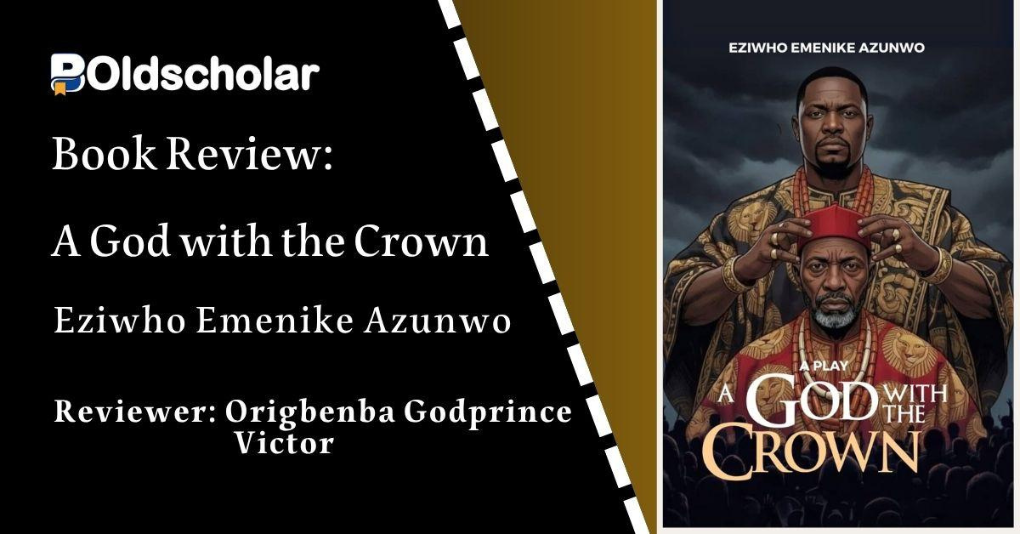
Book Title: A God with the Crown
Author: Dr. Eziwho Emenike Azunwo
Reviewer: Origbenba Godprince Victor
Publisher: Covenant Daystar Publishers
Pagination (Number of pages): 75 pages
Year of publication: 2026
Institution: Rivers State University, Port Harcourt
Department: Theatre and Film Studies
Introduction
Eziwho Emenike Azunwo's A God with the Crown (2025) is a conceived political and spiritual drama that interrogates the fragile relationship between traditional political authority and institutionalised spiritual power within a contemporary African setting. Azunwo, an accomplished playwright and scholar whose body of work consistently engages with questions of power, governance, and social responsibility, here directs his creative attention to one of the most enduring tensions in African political history: the contest between the throne and the altar. The play's title, A God with the Crown, is deeply suggestive, evoking the image of a ruler whose authority is simultaneously political and divine, and raising the question of what happens when that divine sanction is disputed, manipulated, or withdrawn.
The text situates itself firmly within the tradition of African socio-religious and political drama, drawing from ritual language, symbolic settings, and ideologically charged dialogue to dramatise the consequences of spiritual manipulation in governance. As with many of Azunwo's works, this play is less concerned with entertainment in the conventional sense and more with the ethical and social obligations of theatre as an instrument of truth and reform. This review provides a critical examination of the play, considering its themes, narrative structure, characters, language and style, dramatic techniques, and social relevance, while situating it within the broader Nigerian and African dramatic tradition.
Synopsis of A God with The Crown
A God with the Crown is a political and spiritual drama that explores the struggle for power between a traditional king and his chief priest in a kingdom where rulership is believed to be divinely ordained. The play presents a situation in which spiritual authority and political authority become entangled, leading to a crisis of legitimacy and control. The story begins in a peaceful kingdom ruled by a King who is respected for his fairness and calm leadership. Although he governs with restraint, tensions arise within the royal court, particularly with the Chief Priest, who serves as the spiritual intermediary between the gods and the throne. The Chief Priest expects absolute obedience from the King in matters of ritual and governance, but the King begins to question some of his spiritual directives, insisting on exercising independent judgment in state affairs. This disagreement gradually creates suspicion and quiet hostility between both figures.
The conflict escalates when the Chief Priest interprets the King’s independence as spiritual rebellion. He begins to frame the King as someone who has lost divine favour, using rituals, divinations, and court influence to convince key palace figures that the gods are displeased with the ruler. Through this manipulation, he successfully turns parts of the court against the King and builds support for his removal. Eventually, the Chief Priest orchestrates the King’s removal from the throne on the grounds that he has been rejected by the gods. The King is dethroned and forced into exile, despite his protests of innocence. His removal creates fear and confusion in the kingdom, as many citizens and chiefs are uncertain whether the decision is truly divine or politically motivated.
In exile, the King is accompanied by Ekene, a loyal companion who supports him throughout his struggle. Determined to reclaim his throne, the King embarks on a journey to seek higher spiritual confirmation of his legitimacy. This journey takes him away from the kingdom to a powerful oracle known as Bola, who is believed to possess superior spiritual authority capable of revealing absolute truth. While the King is in exile, the Chief Priest consolidates power in the palace, maintaining control through fear and continued claims of divine approval. However, instability begins to grow in the kingdom as people struggle under leadership that is no longer widely trusted, revealing the consequences of spiritual manipulation in governance.
At Bola’s shrine, the King presents his case and undergoes spiritual interrogation. Through divination and ritual consultation, the oracle reveals that the King was wrongly removed and that the Chief Priest had manipulated spiritual messages for personal gain. This moment becomes the turning point of the play, as the truth of the conspiracy is fully exposed. The King is then restored to the throne, while the Chief Priest’s actions are condemned as an abuse of sacred authority. The play ends with the re-establishment of order in the kingdom and the reaffirmation of legitimate leadership. Ultimately, A God with the Crown presents a narrative in which political power is shown to be fragile when spiritual authority is manipulated, and where justice is restored through the revelation of truth.
Theme
The concept of theme occupies a central position in literary analysis, as it encapsulates the fundamental ideas a text seeks to communicate. As Morris Weitz argues, a literary theme represents the underlying meaning of a work, often conveyed through the interplay of characterisation, plot development, setting, and dialogue (Weitz, 2002).
Power Struggle and Political Legitimacy
The play foregrounds the instability of political authority within a traditional kingdom where legitimacy is continuously negotiated. The King’s authority is not only challenged politically but is also subjected to spiritual interpretation by the Chief Priest. This creates a situation where rulership becomes dependent on contested spiritual validation rather than stable constitutional or traditional certainty. The eventual deposition of the King demonstrates how political power can be overturned when legitimacy is externally constructed and manipulated.
Manipulation of Spiritual Authority
A central thematic concern is the exploitation of religion for political control. The Chief Priest distorts divine messages to justify political actions, thereby transforming spiritual authority into an instrument of coercion. This reflects a broader critique of how sacred institutions can be appropriated to serve personal ambition. The play presents spirituality not as a neutral moral force but as a contested site of ideological struggle.
Corruption and Abuse of Institutional Power
The narrative exposes the vulnerability of both political and spiritual institutions to corruption. The Chief Priest’s actions illustrate institutional abuse, while the susceptibility of palace actors to manipulation highlights systemic weakness. The play suggests that when institutional power is not regulated by ethical accountability, it becomes a mechanism for domination rather than governance.
Truth, Justice, and Restoration of Order
The eventual revelation at Bola’s oracle introduces the theme of truth as a corrective force. The King’s restoration is framed as the re-establishment of moral and cosmic balance after a period of distortion. This thematic strand aligns justice with the disclosure of hidden realities, suggesting that political stability is contingent upon the recognition of authentic spiritual truth rather than manufactured authority.
Loyalty, Betrayal, and Ethical Responsibility
The play contrasts unwavering loyalty, represented by Ekene, with institutional betrayal embodied by the Chief Priest. Loyalty is presented as an ethical commitment that sustains legitimacy during crisis, while betrayal destabilizes both governance and communal trust. This thematic opposition underscores the moral dimension of political relationships within the narrative.
Religion and Governance Interface
A further thematic concern is the interdependence and tension between spiritual and political systems. The play interrogates the extent to which religious authority should influence governance, particularly when spiritual leaders assume political functions. It ultimately problematises the fusion of sacred and political power, showing how such entanglement can lead to institutional collapse.
Characterization
The King
The King is characterized as a legitimate ruler whose authority is both political and divinely sanctioned. He is presented as rational, reflective, and increasingly independent in his decision-making. His characterization evolves from a stable sovereign to a contested figure whose legitimacy is questioned by spiritual authorities. Through his resistance to blind ritual compliance, he embodies the tension between pragmatic governance and religious orthodoxy. His exile further reinforces his portrayal as a symbolic victim of institutional manipulation rather than personal incompetence.
The Chief Priest
The Chief Priest is characterized as the principal antagonist and represents institutionalized spiritual authority. He is portrayed as calculating, influential, and strategically manipulative. Rather than serving purely as a moral or religious guide, he exploits spiritual beliefs to consolidate political power. His characterization is developed through his ability to reinterpret divine messages in ways that serve his interests. This positions him as a figure who weaponizes religion for political control, thereby destabilizing the moral order of the kingdom.
Ekene
Ekene functions as a loyal companion to the King and is characterized by steadfast loyalty and moral clarity. He does not engage directly in political manipulation but serves as a stabilizing presence for the King during exile. His role is largely supportive, reinforcing the legitimacy of the King and providing emotional and strategic support during the search for truth. He represents fidelity and continuity in a context of institutional betrayal.
Bola (The Oracle)
Bola is characterized as a higher spiritual authority whose role is to provide impartial divine judgment. Unlike the Chief Priest, Bola is not influenced by political considerations. He functions as a narrative instrument of truth and restoration. His characterization is grounded in neutrality and authority, as he clarifies the distortion introduced by the Chief Priest and restores legitimacy to the King.
Minor Palace Figures and Chiefs
Secondary characters, including palace attendants and chiefs, are characterized collectively as politically responsive and largely opportunistic. Their loyalty is shown to be unstable and influenced by perceived spiritual and political advantage. This group characterization reinforces the theme of fragile allegiance within systems of power, where conviction is often secondary to survival and self-interest.
Language and Style
Azunwo employs symbolic dialogue and ritualistic theatricality. Interactions among characters are shaped by proverbs, metaphors, and indirect expressions rather than plain speech, reflecting indigenous patterns of communication. Scenes in the palace and community settings maintain controlled, respectful exchanges, while shrine scenes adopt incantatory and authoritative language that emphasizes spiritual power and tension. The frequent use of proverbial statements functions both as a means of communication and as a reflection of communal wisdom, reinforcing themes of justice, leadership, and moral order. The speech of the Chief Priest and Bola carries a performative weight, serving not only as dialogue but also as an assertion of spiritual dominance and control. The integration of drumming, chants, and ceremonial movement punctuates key moments in the play, linking it to African performance traditions and intensifying dramatic atmosphere. Stage directions are detailed and deliberate, ensuring that both the ritual elements and the symbolic meaning of the narrative are effectively conveyed in performance.
Dramatic Techniques
Ritual Performance Language: The play deploys incantatory, cosmological, and proverbial speech to construct spiritual authority theatrically, blurring the boundary between governance and sacred performance and lending the Chief Priest's manipulation its dangerous persuasive power.
Symbolism: Key elements such as the throne, the oracle's shrine, and the exile journey function as layered symbols of legitimate authority, spiritual truth, and the loss and recovery of power respectively.
Dramatic Irony: The audience is frequently aware of the Chief Priest's manipulative intent while the palace figures around him remain deceived, creating sustained dramatic tension and moral discomfort throughout the play.
Interrogation and Revelation as Structure: The shrine consultation with Bola provides a courtroom-like dramatic framework that mirrors the interrogation structure in Azunwo's Inconsequential, emphasising truth-seeking, accountability, and the restoration of justice as central theatrical concerns.
Tragedy and Restoration: The play follows a tragic arc in its movement from order through crisis to eventual resolution, structuring its moral argument around the consequences of institutional abuse and the redemptive power of truth.
Socio-Political Commentary
At its heart, A God with the Crown is a political play dressed in spiritual garments. It addresses questions that resonate deeply within the Nigerian and broader African political experience: the manipulation of religion to legitimise power, the vulnerability of traditional institutions to corruption, and the consequences of governance that is severed from ethical accountability. The kingdom of the play, while traditional in setting, functions as a transparent metaphor for contemporary political structures in which those who control narratives of legitimacy, whether spiritual, legal, or institutional, can determine the fate of leaders regardless of their actual conduct or competence.
The play raises urgent questions about the relationship between religion and governance that extend well beyond its immediate dramatic context. By demonstrating how spiritual authority can be weaponised to remove a legitimate ruler, Azunwo critiques the uncritical deference to institutional claims of divine sanction that continues to characterise many political environments across Africa and beyond. The restoration of the King through a higher oracle's truth also carries a reformist message: that accountability and justice are achievable, but only when truth-seeking institutions remain insulated from political corruption.
Comparative Perspective
A God with the Crown aligns with a rich tradition of African drama that interrogates the intersection of political power and spiritual authority. Like Wole Soyinka's Death and the King's Horseman and Ola Rotimi's The Gods Are Not to Blame, it engages deeply with the tension between traditional cosmology and the exercise of political power, using the theatre as a space for examining the moral foundations of governance. Closer in thematic spirit to J. P. Clark's Ozidi and Femi Osofisan's examinations of justice and institutional order, the play demonstrates how the African dramatic tradition has consistently returned to questions of legitimate authority and the corruption of sacred structures.
Within Azunwo's own body of work, A God with the Crown stands alongside Akpako Master and Inconsequential as part of a sustained dramatic project examining institutional failure across multiple domains, whether educational, political, or spiritual. Where Inconsequential trains its lens on the examination board and Akpako Master on the legislative assembly, A God with the Crown extends the critique to the intersection of traditional governance and religious authority, demonstrating both the breadth of Azunwo's social vision and the consistency of his commitment to theatre as an instrument of civic and moral reflection.
Critical Evaluation
Strengths of the Play: One of the most notable strengths of the play is its strong thematic foundation. The text presents a clear exploration of power, legitimacy, divine authority, and justice. The conflict between the King and the Chief Priest effectively dramatizes the tension between political leadership and religious authority. This central opposition sustains the narrative and provides a coherent ideological framework for interpreting the play.
The play also demonstrates cultural authenticity through its use of proverbs, ritual language, and traditional belief systems. Dialogue is heavily infused with proverbial expressions and symbolic speech, which reflect indigenous modes of communication. This stylistic choice enhances the cultural depth of the play and situates it firmly within an African dramatic tradition.
Weaknesses: The play also tends toward excessive didacticism. Themes such as truth, justice, and divine order are often stated directly rather than revealed through subtle dramatic action. This explicit moral messaging reduces interpretive flexibility and can make the narrative appear predictable. Another limitation is the linearity of the plot. The progression from conflict to resolution follows a straightforward path with minimal complications or subplots. The absence of dramatic twists or sustained tension weakens the dramatic intensity of the play.
Conclusion
Eziwho Emenike Azunwo’s A God with the Crown is a thought-provoking dramatic text that interrogates the delicate and often contentious relationship between political authority and spiritual power within a traditional African setting. Through its well-structured plot, compelling characterization, and rich thematic concerns, the play exposes the dangers inherent in the manipulation of religious institutions for political advantage. The conflict between the King and the Chief Priest not only drives the narrative but also serves as a broader critique of leadership systems where legitimacy is subject to ideological distortion.
The play’s exploration of power, corruption, loyalty, and justice situates it firmly within the tradition of African political and socio-religious drama. By dramatizing the consequences of institutional abuse and the eventual restoration of truth through a higher moral authority, Azunwo reinforces the enduring relevance of ethical governance and accountability. The integration of ritual language, symbolic settings, and dialogic tension further strengthens its dramatic impact, making it both intellectually engaging and theatrically viable.
Ultimately, A God with the Crown extends beyond its immediate narrative to function as a reflective commentary on governance, belief systems, and societal order. It underscores the necessity of maintaining clear boundaries between spiritual influence and political power, while affirming that justice and legitimacy can only be sustained through truth and moral responsibility.
Share this post


Be the first to comment on this post