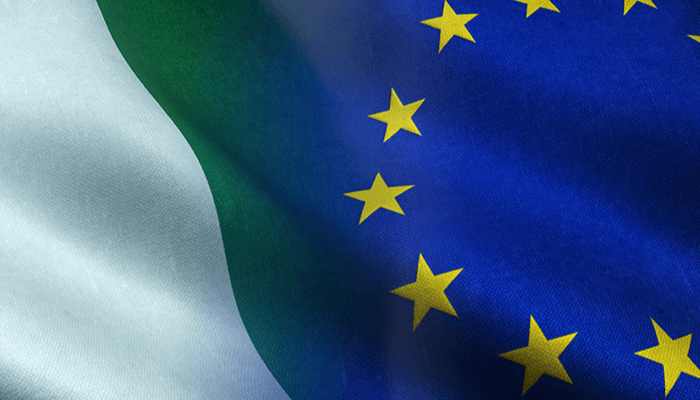
Nigeria and the European Union signed a historic science and technology pact, ending a 20-year hiatus. The pact aims to drive measurable innovation and scale startups across Africa through proactive implementation.
Gautier Mignot, head of the EU delegation to Nigeria and ECOWAS, and his team signed on behalf of the EU in Abuja on Monday, while science and tech minister Kingsley Udeh signed for Nigeria.
Mr Udeh said the agreement marked a milestone by positioning Nigeria as a central hub for scientific advancement in Africa.
Speaking on the historic nature of the deal, the minister said it was the first such agreement the European Union had undertaken with any country in over two decades.
He said that to prevent the agreement from becoming “cold, stuck on shelves”, a dedicated EU-Nigeria Joint Science and Technical Cooperation Committee was established.
He said the committee was tasked with moving beyond standard action plans to creating deliberate strategies for both direct and indirect cooperation.
“The significance, the historic importance of this moment, is not lost on us at all,” the minister said.
He reiterated that Nigeria was committed to matching words with action, with concrete outcomes expected to be reported at the upcoming ministerial meeting in Addis Ababa.
The partnership specifically targets the growth of Nigeria’s technological sector, which already produces the majority of Africa’s “unicorns” (startups valued at over $1 billion).
By providing structured support through this international framework, the government aims to foster the emergence of more Nigerian tech giants and encourage the growth of similar innovative ecosystems across Africa.
It would also translate local ingenuity into measurable industrial and economic impact.
The minister confirmed that the initiative aligned with the federal government’s Renewed Hope Agenda, which places innovation at the heart of national development.
Mr Mignot said that while cooperation was already active, the new agreement aimed to provide legal and political frameworks to upscale the relationship.
He said it moves the partnership beyond informal collaboration to a structured environment, conducive to accelerated growth and greater visibility for past and future accomplishments.
Mr Mignot said that the partnership was anchored in Horizon Europe, the world’s largest science and technology programme.
He explained that because science is global, Nigerian researchers and institutions should integrate into the nearly €100 billion initiative to foster universal knowledge exchange.
According to him, the EU identifies Nigeria as a significant hub of innovation, research and science.
The agreement is designed to empower innovators and create pathways for joint research projects and academic exchanges, among others.
Share this post

Be the first to comment on this post