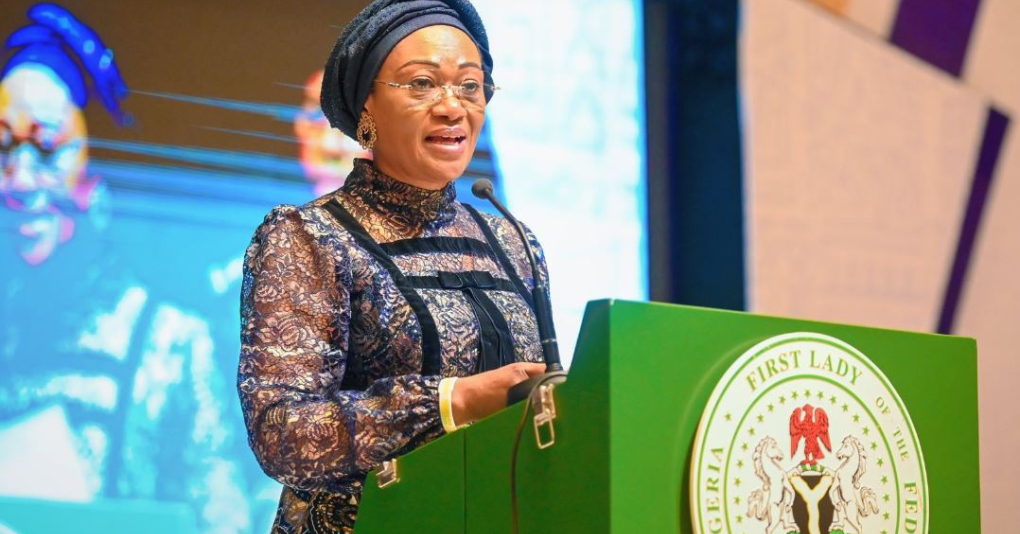
The First Lady, Oluremi Tinubu, on Monday told a World Bank delegation that the Federal Government would establish a properly structured school feeding programme before the end of President Bola Tinubu’s tenure.
She said the President had been passionate about the initiative since his days as governor of Lagos State.
Mrs Tinubu made the assurance while receiving a five-member World Bank delegation led by the Country Director for Nigeria, Dr Matthew Verghis, at the State House, Abuja,
In a statement she signed Monday, Senior Special Assistant on Media to the First Lady, Busola Kukoyi, said the discussions centred on the bank’s Early Childhood Development programme and its five-year implementation roadmap for Nigeria.
The statement is titled ‘First Lady Oluremi Tinubu Receives World Bank Team.’
It quoted the First Lady as saying, “We are looking forward to school feeding. I can assure you that before we finish our tenure, it would have been properly established, because even Mr President is very passionate about this, even when he was Governor in Lagos State.”
She described early childhood development as critical not only to improving growth opportunities for children but to shaping and sharpening their focus, and assured the delegation that her office would continue to work with wives of state governors to drive targeted interventions for children across the country.
The First Lady also highlighted the multi-sectoral approach already being deployed across health, environment and education under the Tinubu administration, citing her collaboration with the Minister of Environment as one example.
“The ministries have also been doing their best for the benefit of our nation, with the environment and sanitation, because environmental cleanliness is very key.
“I worked with the Minister of Environment to an extent, and that was why we started the Green Challenge,” she said.
Mrs Tinubu praised the administration’s cabinet for its commitment and affirmed that a whole-of-government approach was already in operation.
“Mr President has gotten himself a wonderful team. They get it,” she said.
She also cited the administration’s tuberculosis sensitisation campaign as an example of the kind of public health communication she intended to extend to child welfare.
Verghis, in his remarks, described Nigeria as one of the World Bank’s most important global partners and said the bank’s success in meeting its own internal targets depended significantly on Nigeria’s progress.
He stated, “Nigeria is a very important partner for the World Bank, and her success is crucial for the World Bank to achieve its targets.
“We have targets for healthcare delivery, broadband access and energy access, and for these various things, if Nigeria does not succeed, the World Bank is not succeeding.”
The World Bank country chief explained that the Early Childhood Development strategy encompasses boosting nutrition and healthy living from pregnancy to age five, and that investments in that window yielded strong annual returns by enhancing cognitive skills, lowering long-term health costs and breaking multi-generational poverty cycles.
He explained, “Every five or six years, we reframe our programmes in Nigeria. Nigeria is unsurprisingly one of the World Bank’s largest partners and our office here is one of the largest in the world.”
Verghis acknowledged that the long-term nature of ECD returns made political commitment harder to sustain, but said that was precisely where leadership was indispensable.
According to him, “One downside is that the returns come much later. Sometimes, not everybody is willing to take that long-term perspective; it requires leadership to make that happen. The returns don’t come quickly, and therefore it requires leadership.”
He called on the First Lady to use her platform to fast-track a multi-sectoral approach to the programme, noting the strong alignment between her ongoing campaign against child malnutrition and the World Bank’s programming in education, nutrition and sanitation.
The delegation was in the First Lady’s office to brief her on the bank’s early years programme in Nigeria for the next five years, currently at its technical and analytical phase, ahead of what the bank described as a full implementation phase to be driven through a whole-of-government approach.
Share this post


Be the first to comment on this post