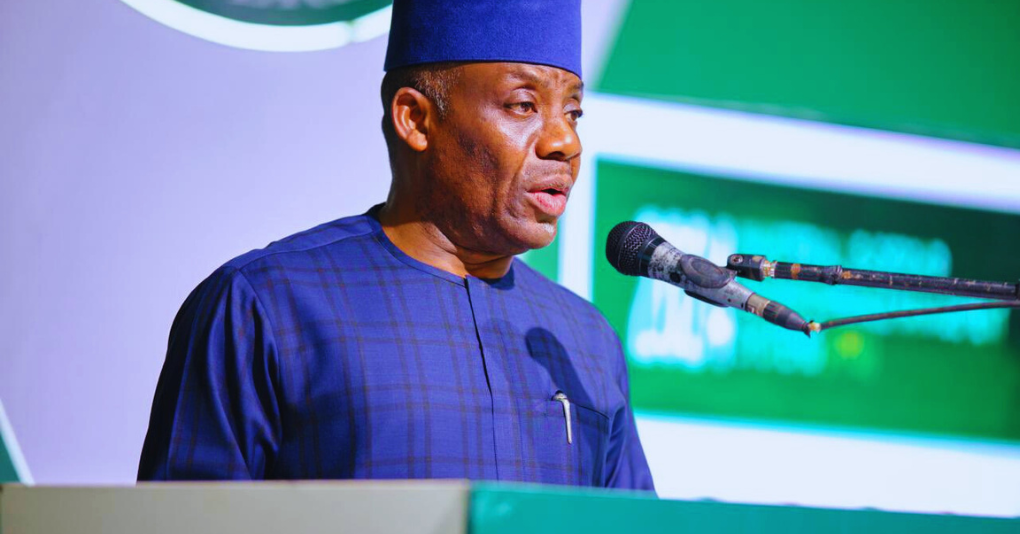
The Federal Government has revived 16 abandoned digital e-library projects across Federal Unity Colleges and commissioned a state-of-the-art digital hub at the Federal Government College, Kano, as part of efforts to modernise public schools and expand access to technology-driven learning.
The Minister of Education, Dr Tunji Alausa, disclosed this on Monday while commissioning the upgraded digital e-library during an inspection of key Federal Government education projects in Kano State, according to a statement issued by his office.
Alausa, who was accompanied by the Minister of State for Education, Prof. Suwaiba Ahmad, said the rehabilitation of the abandoned facilities underscored the Tinubu administration’s commitment to repositioning public education through digital infrastructure.
“This upgraded digital e-library is another significant milestone in the Federal Government’s drive to prepare Nigerian students for a digital future. It provides our students with a world-class environment where they can acquire the digital literacy and critical thinking skills required to compete in today’s knowledge economy,” the minister said.
The newly commissioned digital hub at FGC Kano is equipped with solar power, air conditioning, modern lighting and nearly 80 computer workstations designed to enhance teaching, learning and research.
“With solar power, modern computer workstations, air conditioning and reliable digital infrastructure, this facility will serve as a hub for innovation, research and learning. We are investing not just in buildings but in the future of our children,” Alausa added.
The minister revealed that the present administration inherited 36 abandoned or poorly executed e-library projects across Federal Unity Colleges but, through the intervention of the Universal Basic Education Commission, had successfully rehabilitated and completed 16 of them.
“When we assumed office, we inherited 36 abandoned and poorly executed e-library projects across our Unity Colleges. Through the intervention of the Universal Basic Education Commission, we have successfully revived and completed 16 of these facilities. This demonstrates our resolve to modernise public schools and ensure Nigerian children have access to education that meets global standards,” he said.
He stressed that expanding digital infrastructure remained central to the Federal Government’s education reform agenda.
“Digital learning is no longer optional; it is essential. Every Nigerian child, irrespective of where he or she lives, deserves access to technology-enabled education that prepares them for the future,” the minister said.
During the visit, Alausa interacted with students of Federal Government College, Kano, expressing satisfaction with their confidence, communication skills and academic outlook.
He described the students as a reflection of President Bola Tinubu’s human capital development agenda and commended the school management and teachers for preparing learners to thrive in an increasingly knowledge-driven economy.
Speaking on the proposed Public-Private Partnership land-swap initiative at the college, Alausa reaffirmed that the Federal Government would not reverse the policy.
He explained that responsibly leveraging underutilised land would generate resources needed to provide better classrooms, hostels and other critical infrastructure without compromising students’ welfare.
“Our responsibility is to ensure that every policy translates into better opportunities for our students. We have no interest other than providing quality education and improved infrastructure for Nigerian children,” he said.
The minister added that the Federal Government remained open to engaging the college’s old students and other stakeholders willing to partner in the institution’s development through similar initiatives.
Earlier, Alausa inspected the Bilingual School in Ungogo, where he expressed satisfaction that construction had reached about 90 per cent completion and directed officials to commence teacher recruitment and other operational preparations ahead of the school’s planned opening in September.
He disclosed that a third bilingual school would commence academic activities at the beginning of the 2026/2027 academic session, while a fourth school is expected to become operational by June 2027.
The minister described the bilingual school initiative as one of the Federal Government’s most effective responses to Nigeria’s out-of-school children crisis because it integrates Almajiri and other vulnerable children into formal education while equipping them with knowledge, skills and values.
“The bilingual school initiative is one of the Federal Government’s most impactful responses to the challenge of out-of-school children,” he said.
Alausa further disclosed that the Nigeria Education Sector Renewal Initiative had returned more than one million out-of-school children to classrooms within the last 24 months.
“Beyond bringing children back to school, we are focused on ensuring they remain in school through improved teaching, better learning environments and sustained support that will translate into stronger learning outcomes,” he added.
The commissioning of the FGC Kano Digital Hub forms part of the Federal Government’s broader education reform programme under the Nigeria Education Sector Renewal Initiative, which is driving the implementation of President Bola Tinubu’s Renewed Hope Agenda for Education.
The initiative prioritises reducing learning poverty, tackling the out-of-school children crisis, expanding digital learning infrastructure, strengthening foundational literacy and numeracy, improving teacher quality, and modernising public schools through strategic investments and partnerships.
The Ministry of Education has, in recent months, accelerated reforms across the sector, including nationwide learning assessments, the expansion of bilingual schools for Almajiri and other vulnerable children, the rehabilitation of Unity Colleges, and the revival of abandoned digital e-library projects.
These interventions are designed to equip Nigerian students with 21st-century digital skills, improve learning outcomes and position the country’s education system to compete globally while supporting long-term economic growth through human capital development.
Share this post


Be the first to comment on this post